Team Hot or Team Cold

This is a poll about whether your body temperature runs hot or cold, which actually affects your style choices.

You are on Team Hot when your internal thermostat runs warm. You like to wear fewer layers because you don’t really feel the cold. You can wear sandals and lightweight tops when it’s still fairly chilly outside. You seldom complain that you feel cold, but are more likely to complain that you are hot.

You are on Team Cold when your internal thermostat runs cold. You cover up quite a bit because you are sensitive to feeling cold. You handle warmer temperatures pretty well. And it has to be really hot for you to wear sandals and sleeveless items, otherwise you are happy to layer multiple pieces in order to keep warm.

I am on Team Cold. I am constantly covering up because I feel cold, and I absolutely cannot handle freezing cold air-conditioning. I’m the gal who can wear jeans and leggings in 80 degree weather. I can wear ballet flats and pumps when it’s in the 90’s. When others comfortably wear sleeveless dresses, I’m the one covering up with a denim jacket. I’m always finding “the warm spot” wherever I am.

Over to you. Are you on Team Hot or Team Cold? Tell us why, and no batting for both Teams. You might find that you run neither hot or cold, in which case you bat for Team Temperate.

Fringe Trend: Denim Blazers

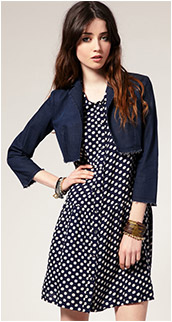
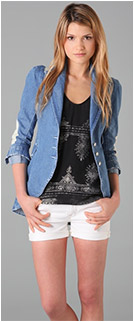
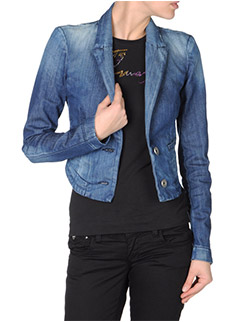
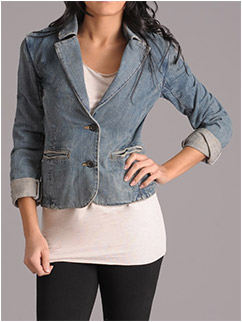
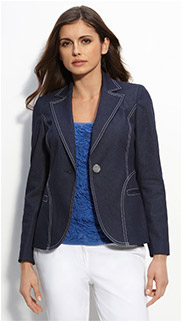
It’s not a denim jacket like the original “Levi’s cut”, which has been around for decades and is still going strong. Instead, it’s cut more like a blazer. Some silhouettes are classic, whereas others are fashion forward and edgy. The wash and texture of the denim can vary too. Faded denim blazers have a distinctive 70′s feel about them. Dressier styles, like the one from Anne Klein below, are more preppy.

I love denim clothes and the denim blazer, whether classic or fashion forward, is fab in my book. I like denim blazers best paired with a non-denim ensemble, but appreciate a spunky denim-on-denim look too. As with most denim products, it adds a relaxed, casual, hip and youthful edge to your outfit.

I have two cropped Levi’s-style denim jackets that are absolute wardrobe work horses. I am always looking for cover-ups because I easily feel cold. So I am not at all opposed to adding a spunky denim blazer to my wardrobe. After all, smart casual is my favourite dress code.

I vote yay. If the right denim blazer comes along, fabulous! I know I’d especially wear it with dresses, skirts, white bottoms, tweedy trousers and shorts, and silky harem pants. What’s your verdict?

This post contains affiliate links.

Karen Kane’s Trim and Dispatch Departments

We took you through the start of the clothing production process this morning. Now it’s time to finish off the orders and send them off to retailers so that customers like you and I can fab goodies to our wardrobes.

The process below takes care of the “trim” part of CMT (an abbreviation for “cut, make and trim”). To refresh your memories, Karen Kane does the cutting, but the garments are contracted out to nearby sewing rooms to be sewn together.

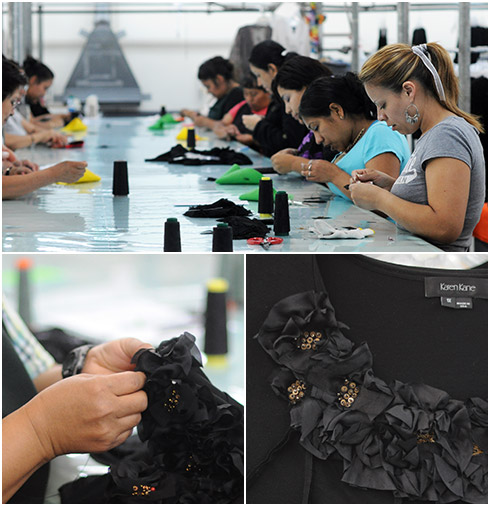
Garments often come back from sewing rooms in an “almost complete” state. For example, these black knit tops were redelivered to Karen Kane so that the beads could be sewn onto the rosettes by hand, which is precisely what these nice ladies are doing here.

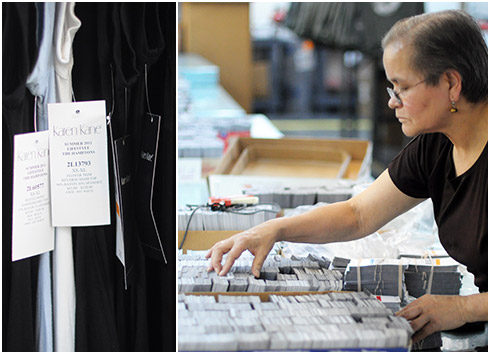
The finished garments also have to be correctly finished off with swing tickets and hangers, which are retailer specific. Garments are still ticketed by hand! The swing ticket is actually an extremely important little piece of card, because it contains not only the brand’s name, the retailers name, size and style number, but also the bar code and SKU number, without which retailers cannot track garments. Think how often you ask a sales assistant to track down a garment for you. It’s possible because of the information on the swing ticket. Sometimes, similar information is available on the sewn in label.

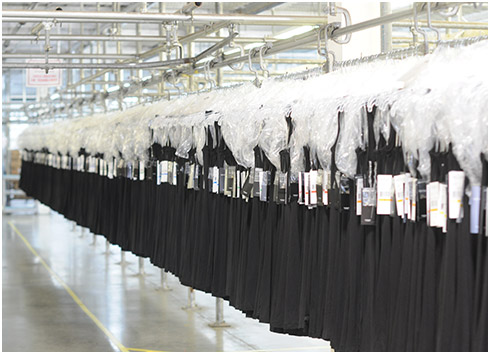
These garments are trimmed and ready to go! The Karen Kane label is especially known for it’s short, black knit dresses that drape like a dream — of which I have a few. Here is a style just like that heading for the dispatch area, which as you might have guessed is HUGE.

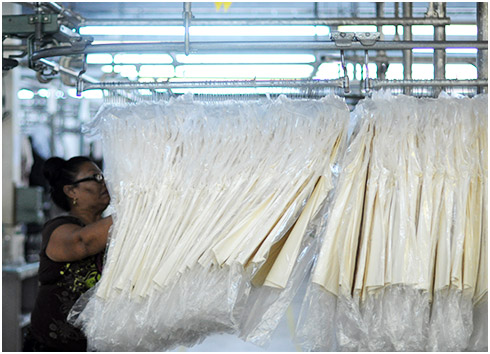
These garments are also ready to be dispatched. This style is one of Karen Kane’s oldest and best selling items that they produce year after year. It’s a simple nylon/spandex tank top with built up sleeves, available across an assortment of colours. I have one in black and white that I wear all the time.

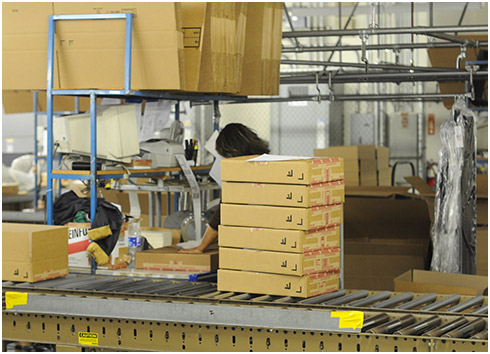
Finally, the dispatch area, where orders are boxed and shipped to their respective retailers and boutiques. Soon with the launch of Karen Kane’s new online store on 1st July, orders will be shipped from here to another warehouse where they will await your order.

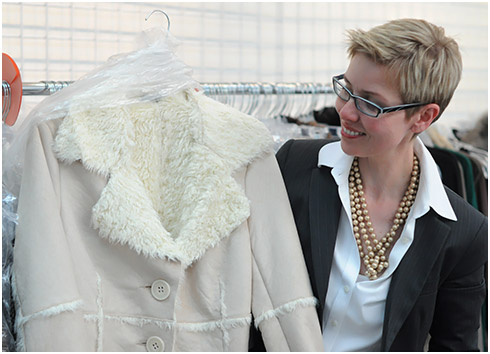
We went back to the main conference room after our tour of the factory facility, where I couldn’t wait to lay my hands on the final sample of the Shearling jacket that I saw being hand cut on the cutting tables only an hour ago. When you like and appreciate the environment in which an item was made, it changes it’s status from great to magical.

Although I’ve visited many a factory floor, it was fun and interesting to see the Karen Kane operation in action. Their facilities are extremely clean, ventilated and organized, which really appeals to the neat-freak in me. The employees are friendly, knowledgeable and helpful, which made the experience even more fab!

This is the fourth in a series of posts sponsored by Karen Kane:

  1. Design at Karen Kane
  2. Karen Kane’s Sample Room
  3. Clothing Production at Karen Kane
  4. Karen Kane’s Trim and Dispatch Departments (this post)
  5. Karen Kane the Family Business

For more information you can follow @Karen_Kane on Twitter or like their page on Facebook.

Roundups

Simpler Items

This week's list of top picks list is about basic pieces.

Read More

Assorted Items

Items for Summer, both in and out of air conditioning.

Read More

Casual Summer Vibes

This week's top picks are good for a casual Summer vibe.

Read More

Summery Earth Tones

These items are for those who like to wear casual earth tones in warm and hot weather.

Read More

Hints of Spring

Some tried-and-tested winning items to refresh your style for Spring.

Read More

Dressier Items

An assortment of dressier top picks might be just what the doctor ordered.

Read More

Clothing Production at Karen Kane

This is the third in a series of sponsored posts where we look behind the scenes at American clothing company, Karen Kane.

Last week we took you through Karen Kane’s Design Process and Sample Room, which is where a new garment is born and refined. Once the collections are ready, Karen’s husband Lonnie, eldest son Michael, and a group of account execs and sales reps show the items “at market” several times a year, which is where fashion buyers from different retailers and boutiques view the collections and place orders. “Coming back from a good market”, as Lonnie puts it, is one of his favourite parts of this business. Karen and her team reap the reward of their hard work when a style comes back with an order for production.

My fashion buying days took me to factories in Asia, Africa and Europe, so I have seen first hand what can go wrong in clothing manufacture. There are many moving parts and production relies heavily on the strength of each link in the chain, so there is lots of room for error. Good grief! Let’s just say that the word “contingency plan” takes on a new meaning in this business. That’s why I have the utmost respect for clothing manufacturers. It’s an extremely stressful job at the best of times.
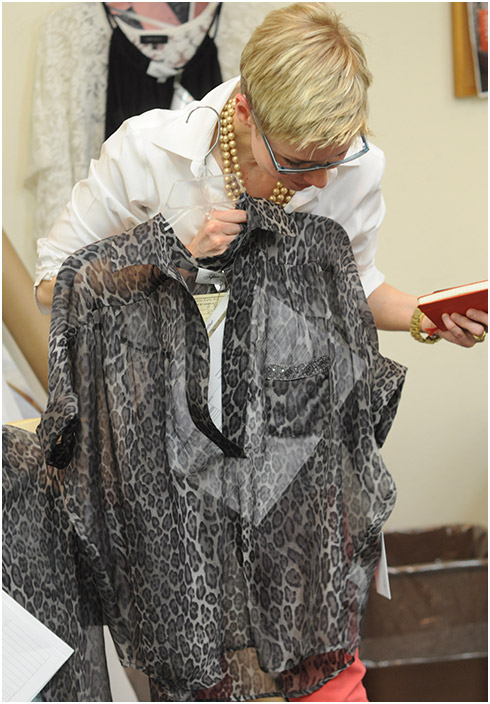
The very cool, calm and collected Karen took us around the factory floor, although hubby Lonnie actually runs this side of the show. To use Rag Trade lingo, the “Cut, Make and Trim” process starts right here and it’s abbreviated “CMT”. A final sample that is sold at market, like this gorgeous animal print blouse, receives a cutting order (the sheet that’s attached to the garment) and heads down to the cutting facility.
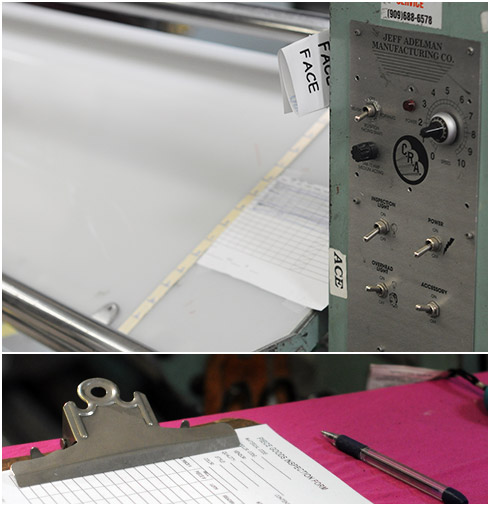
Karen Kane orders fabric from France, Italy, China, the United States and a variety of other countries. The fabric rolls are inspected as soon as they arrive. You can’t see whether fabric is damaged when it’s on the roll. so onto the inspection machines it goes, where each square inch is checked and double checked. The weight, colour, texture, composition and weave has to be just as was ordered. Fabric that is flawed, or not as the order specified, is returned right away.
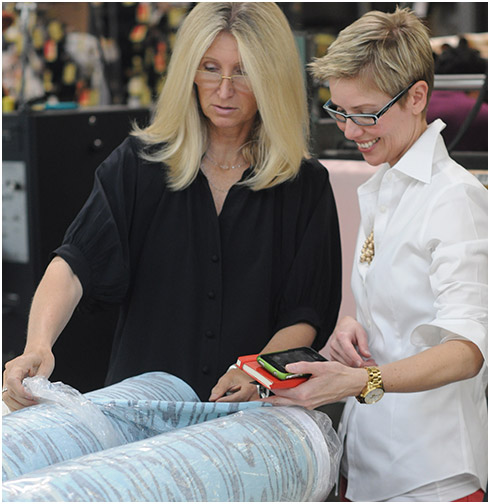
Here Karen and I are looking at “approved” fabric. Yes! That means that the order is one step closer to being cut.
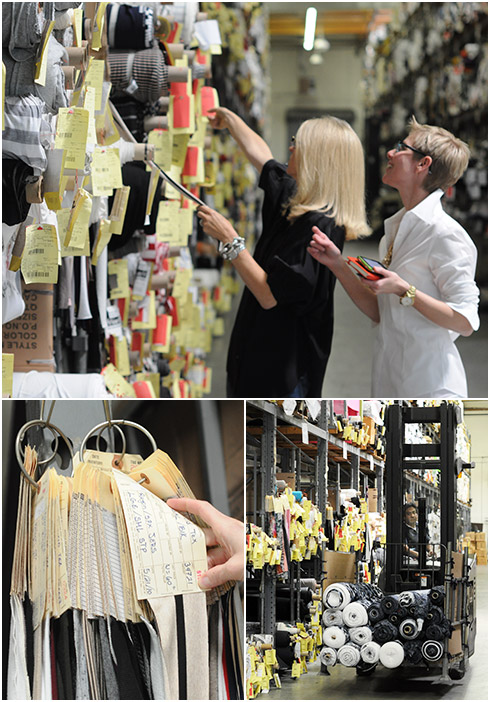
When you produce five labels like Karen Kane, there is a LOT of fabric moving on and off the factory floor. Fabric has to be stored before it’s cut. The fabric storage area is gigantic and trying to find a specific set of rolls can be like looking for a needle in a haystack. Enter their effective cataloguing system on the bottom left of the photo above. A swatch of fabric is marked with it’s precise location: Section 39, Row B. How organized and efficient. Love that.

When fabric sits in the storage area, surprisingly, it’s not always safe. Sometimes the factory lights cause it to discolour, or the metal shelving causes indentations that damage the fibres. More problems to solve, which is just par for the course on any given day in the world of clothing manufacture.
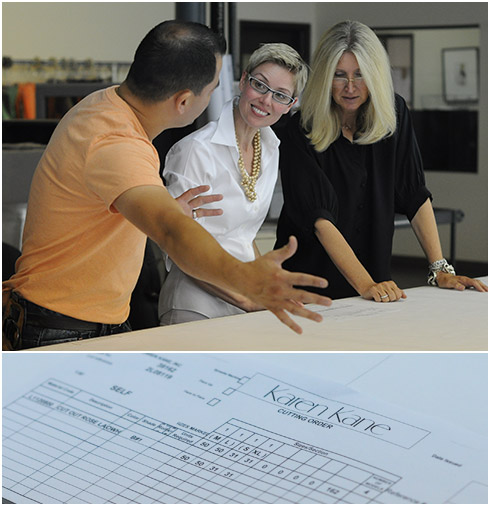
The grading process, when ALL the sizes of an order are created from the sample pattern, happens before the pattern pieces are actually cut. This gentleman above is a pattern grader, and it’s his responsibility to make sure that the graded sizes and their ratios are correct because he operates the grading machine. He works directly from the cutting order and adheres to the size curve. Years ago, I used to grade patterns by hand and it’s an extremely finicky and labour intensive process. So glad that we don’t have to grade things by hand anymore!

Once the patterns are graded, the information is loaded onto a computer where it’s an absolute skill to lay out the pattern pieces so that there is minimum fabric wastage. The lovely gentleman behind this computer plays around with many, many pattern laying configurations until he has the optimum solution. So essentially this process is still done by hand. Computers do NOT work out the best pattern lay. Isn’t that amazing?
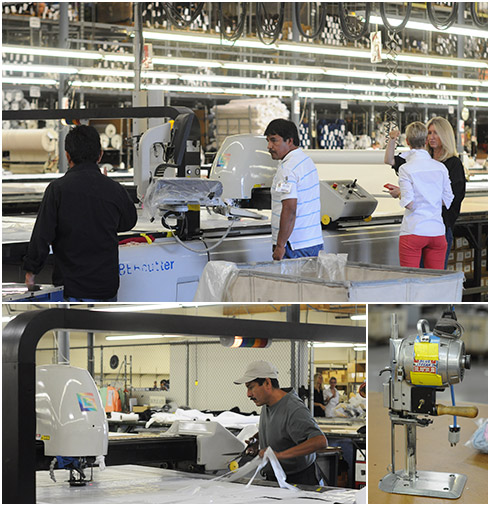
At last we’re ready to cut the fabric! The cutting tables take up almost the entire length of the factory floor. The fabric is unrolled and layered across the length of the tables. It stretches as it’s unrolled, so it has to “rest and recover” for a couple of days before it sees the blades of a cutter.

The layers of fabric are heavy, so when the time comes to feed it through the cutter, air blows through little holes on the cutting table to assist movement.

A template of the pattern lay is fed into a Gerber Cutter, an enormous computer operated machine that moves on tracks across the factory floor. It moves from one cutting table to the next, cutting out pattern pieces through hundreds of layers of fabric. But you know how it goes, all machines break down, and when that happens, out comes the electric hand cutter that you see in the bottom corner of the above photo. Everything has a contingency plan.
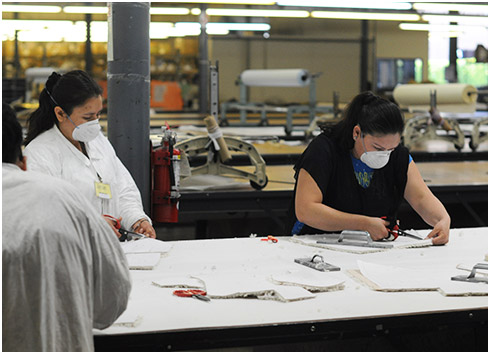
In some instances, fabric has to be cut completely by hand, which these fabulous ladies are doing with shearling fabric. You are not allowed to cut the hair of shearing fabric, just the backing, so no fancy Gerber cutter here. It’s all controlled by the human hand. The masks are to prevent fabric fluff from irritating nasal passages.
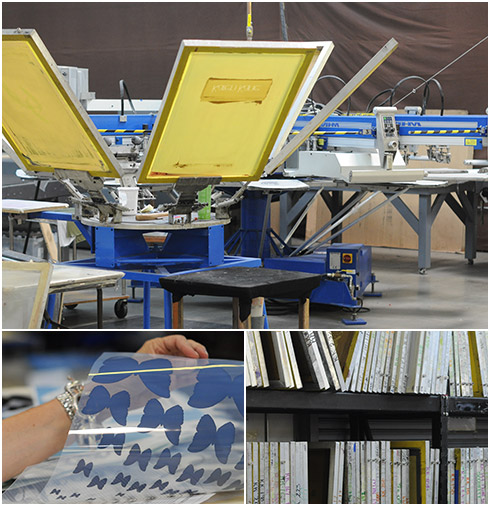
Some styles require a printed pattern somewhere on the garment. The screens are cut from a prescribed design and the panels are printed and dried right on the premises. The factory keeps a library of screens on hand.
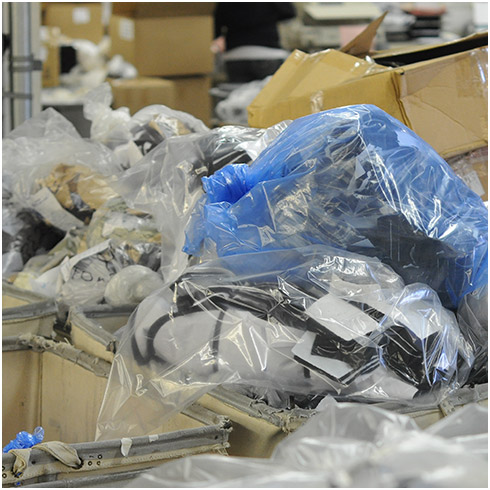
The cut pattern pieces are finally bundled up, per order, into bags ready for the sewing rooms. The bundles also contain everything else required to make the garment, like zippers, buttons and labels.

The next part of the process is the “make” part of CMT, which doesn’t actually happen on the premises. The bundles of cut fabric and trim are delivered a few of blocks away to a company that Karen Kane contracts for sewing the garments. The almost completed product is delivered back to Karen Kane for the finishing touches, which constitutes the “trim” part of CMT. You’ll hear all about that this afternoon.

Well, that’s just an ordinary day at Karen Kane. It is a complex operation with lots of room for error, where the term “contingency plan” takes on a whole new meaning! Lonnie and Karen have to deal with new challenges every day. And they take it all in their stride.
This is the third in a series of posts sponsored by Karen Kane:

  1. Design at Karen Kane
  2. Karen Kane’s Sample Room
  3. Clothing Production at Karen Kane (this post)
  4. Karen Kane’s Trim and Dispatch Departments
  5. Karen Kane the Family Business

For more information you can follow @Karen_Kane on Twitter or like their page on Facebook.
Don’t Pump the Mascara Tube

Until recently I would energetically pump the tube before applying mascara to my lashes. By pumping I mean vigorously moving the brush around in the mascara tube to get a good coat of lash paint onto the brush. One of my clients, who has been in the beauty industry for decades, mentioned that pumping the brush causes liquid mascara to go clumpy and thick. It has something to do with the addition of air into the solution as you pump that causes the clumps.

My lovely client suggested that a gentle ninety degree twist of the brush is sufficient, and that will keep your mascara solution thin and smooth for longer. So I started a new mascara tube and have religiously NOT pumped the tube.

Who else pumps their mascara tube?