Behind the Seams: The Pattern Maker

Series
“Behind the Seams” is written by Jessica Gold Newman, CEO of Dobbin Clothing in NYC. In case you missed it, here’s more background on Jessica and the series.

Having covered some ground in explaining our fabric selection process at Dobbin, I now want to bring you forward to a more real-time part of the production process: pattern making. 

Since our last entry, we’ve received most, but not all of our Spring 13 Production fabrics. We’re still waiting for some of our new pant, dress and blouse fabrics that we need to complete the collection. We are constantly emailing, calling (and sometimes begging!) fabric agents for updates. It usually all comes together; throughout the process our small team continues to regularly communicate about how best to deal with unexpected turns in the road.

While we deal with fabric hiccups, we’ve also started working with our pattern maker. She works with us on a freelance basis while she works full-time for a mass manufacturer. She’s been in the fashion business for almost 40 years, and is an expert in creating patterns for everything from jeans to red carpet gowns.

Of course, working with her on a part-time basis makes for a lot of schedule juggling, so that’s yet another part of the production puzzle! Many small companies like us use freelance pattern and sample makers because they can’t yet afford to employ them full-time. The other option is to use a pattern service, which is an office of pattern and sample makers and sometimes cutting rooms and production sewers. Pattern services work with small companies and even with larger ones who are in a rush to get a new product to market, and who need an additional resource beyond their in-house pattern makers. Pattern services can be very busy places; we tried working with one, and just felt that our patterns and samples did not get the TLC we demand goes into our Dobbin products.

It’s very hard to find a good pattern maker whether you’re a small or a large company. Pattern making itself has changed a good deal in the past 20 or 30 years. Before patterns could be created by computer programs like CAD (Computer Aided Design), they were all created by draping fabric on a dress form and then drawing up the pattern on paper by hand. Now, many companies who produce on a large scale prefer to use CAD. Patterns are created digitally and sent directly to sample makers or factories for sampling. Many companies who care deeply about the fit of their garments prefer the old-school pattern making techniques. To us, these patterns have more dimensionality and attention to the contours of the body. This kind of pattern making is as much of an art as it is a science.

The dilemma with requiring these techniques is that they’re used mainly by pattern makers who have an enormous amount of experience. And as they retire, there are fewer and fewer of these workers. Younger pattern makers who have graduated from Parsons, FIT or other fashion schools’ pattern making programs either lack experience and knowledge or they work primarily via computer. I’d encourage young people who are interested in a fashion career to think about this lucrative field, and to learn both ways of pattern making. It’s a great job, and one that the fashion industry cannot live without.

In the next post, I’ll touch on how we design our clothes and the considerations we make in the look and fit of each of our products. For now, I will skip that part and do a quick run-down of the beginning stages of working with our pattern maker.

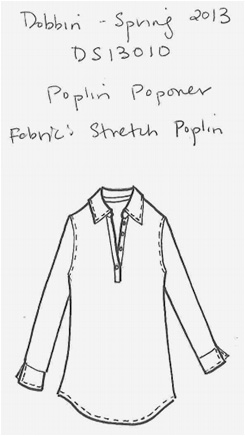
With our sketches, we also hand over optimal measurements for each garment we’ve designed. Our pattern maker then takes the sketches and uses our specially made dress form to create Dobbin-specific patterns.

A few patterns are created at a time. We pick them up from the pattern maker, and then deliver sample fabric and trim (buttons, lining, zippers, etc.) to our sample maker, who sews them for us. We then schedule a fitting, during which Catherine (co-founder of Dobbin and my business partner), our pattern maker and I see the samples on a fit model. We discuss what’s right and wrong about the fit and the feel of the garment, and then our pattern maker goes back and makes the corrections on the original patterns. After the corrections, we make another sample and fit again. We do this three or four times until the fit is perfect, with weeks in between each fitting. We want the fit to be flawless and we won’t settle for less, so the pattern and sample process tends to be the most stressful part of the production process.
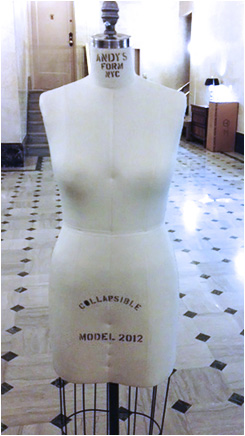
Left: The specially made Dobbin form

Right: Sketch from the Spring 2013 range
How Tall is Tall?

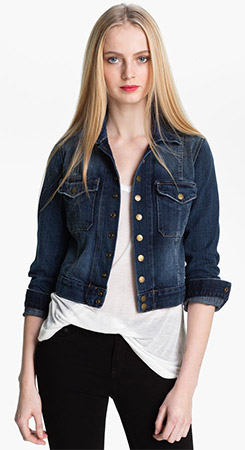
In the US, women’s’ clothing sizes are divided into petite, regular and tall lengths in order to accommodate your height. The departments are based on the assumption that if you’re 5′ 3″ and below, you’re considered “short” or “petite”. Heights from 5′ 5″ to 5′ 7″ are considered “regular”. And a height over 5′ 8″ is considered “tall”.

Generally, I agree with this broad based height classification for women. I tend to go either way with women who are 5′ 4″ — the average height of women in the US — sometimes I perceive it as petite, and sometimes as regular height. I tend to do the same at 5′ 7″, sometimes perceiving it as regular height and sometimes as tall. I think my perceptions have a lot to do with comparisons to my own height. Simplistically, if you’re shorter than me, you’re petite. When you’re taller than me, you’re tall.

In the US, I am 100% regular height standing at 5′ 6″. But when I go the Netherlands I’m considered short because the average height of women there is 5′ 7″. That is quite tall. So I guess height perceptions are pretty relative. 

At what height do you perceive a woman to be tall? What height are you, and do you think of that height as petite, regular or tall?

Four Essential Shopping Tools

I’m not talking about the comfy shoes that are a must for traipsing in and out of stores. Or the refreshments that you bring along to keep fueled and hydrated. Or the great underwear that allows you to achieve your best silhouette when you fit on clothes. 

Of course, these things are important, but here I’m going to focus at a different level. I’ve found that taking a mental box containing four tools is absolutely essential when I shop for myself or with my clients. Whether it’s shopping online for five minutes or shopping in the city for an entire day these tools are important and I try to keep them as sharp as possible. 

  1. Your Style Goals: You need a pretty clear idea of the style you aspire to achieve, and the style you do NOT aspire to achieve. This is why we set style goals in the first place, so that they can keep us focused. In my line of work, where I am constantly tempted by items while shopping with others, they keep me on the straight and narrow. 
  2. A Shopping List: You need a seasonal list of the items you’re looking for, where each item on the list fits into one of four categories.
  3. A Realistic Budget: You need some idea of the amount of money you can spend in a month or season so that you don’t break the bank, or skimp unnecessarily.  
  4. A Good Attitude: You need to be in the right state of mind when you shop. This means shopping for the body you’re in today, being open to new colours, silhouettes and fabrications, and being patient, picky and practical

These tools, which are intuitive for some and more regimented for others, help to create that all important balance between wardrobe discipline and having fun with fashion. Shopping without them is how you end up unhappy with your choices, with a closet full of clothes and nothing to wear.

Roundups

Simpler Items

This week's list of top picks list is about basic pieces.

Read More

Assorted Items

Items for Summer, both in and out of air conditioning.

Read More

Casual Summer Vibes

This week's top picks are good for a casual Summer vibe.

Read More

Summery Earth Tones

These items are for those who like to wear casual earth tones in warm and hot weather.

Read More

Hints of Spring

Some tried-and-tested winning items to refresh your style for Spring.

Read More

Dressier Items

An assortment of dressier top picks might be just what the doctor ordered.

Read More

Your Favourite Rise Measurement For Jeans

I bat for Team Low Rise jeans, which means that I prefer a front rise that measures between six and seven inches on a tailored pair of skinny, straight or bootcut jeans. The back rise measurement is significantly higher to prevent bottom cleavage

I prefer low rises on tailored jeans for three reasons:

  1. I find them extremely comfortable. It all stays put. Front rises that measure eight inches or more tend to dig into my skin, ride up when I sit down and generally feel like too much fabric. 
  2. I like to tuck tops and belt jeans, and find that visually lowering the horizontal cutting line is more flattering for my body type. Belt and tuck with a higher rise and I feel ever so slightly frumpy, although it does visually lengthen my leg line. 
  3. Although I am not short waisted nor short in the rise, I like to create an even longer torso by wearing lower rises with belts and a tucked top. I really like the look of a long torso. 

I don’t mind up to an eight and half inch front rise on boyfriend jeans because I wear them slouchy and therefore with a dropped crotch point. But I still wear the waistband on my hips so that they look low rise, which makes the crotch point drop even further. 

As I replenish my denim capsule this year, I’ve been sharing my thoughts about the hunt for the perfect pair of jeans on our forum. It’s been an interesting process, especially when I compare my own denim fit and fabric needs to those of my clients and our forum members. 80% of my clients prefer a front rise of between eight and nine and a half inches for skinny, straight or bootcut jeans. Some prefer an even higher rise and a couple prefer low rise. I definitely swim against the tide preferring low rise jeans, and because they aren’t on trend or desirable, they are hard to find. 

Over to you. What’s your preferred front rise measurement on tailored or body con jeans? We’ll leave slouchy and baggy styles out of the equation for this poll. Remember that there is no right or wrong answer because it’s a personal preference that is suited to your figure flattery needs and comfort levels.

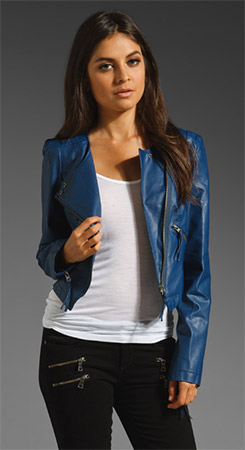
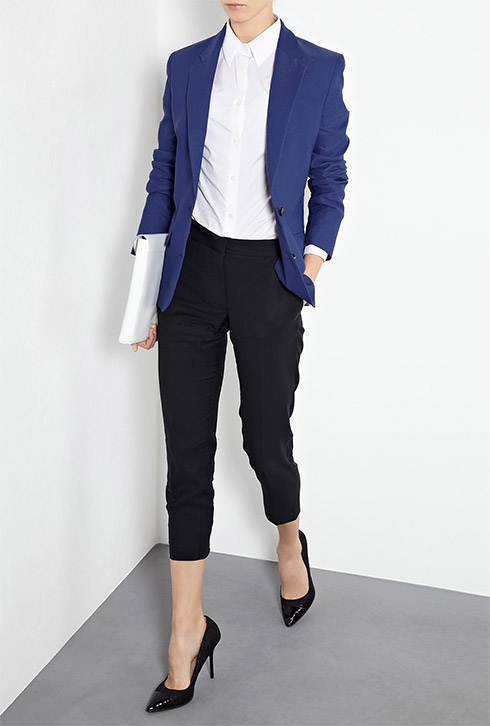
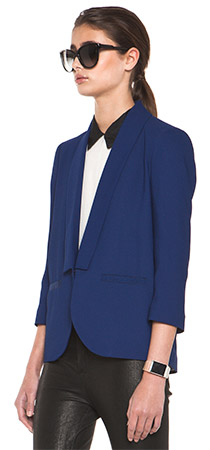
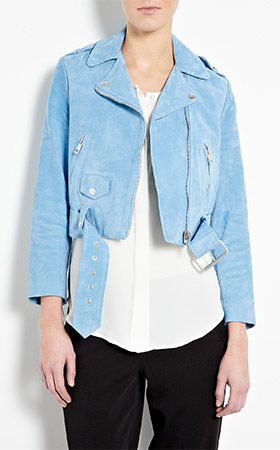
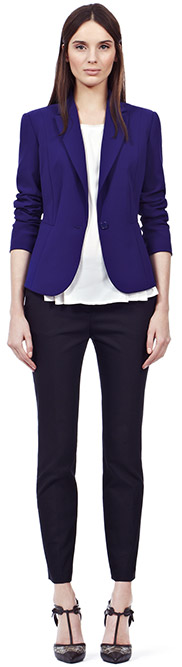
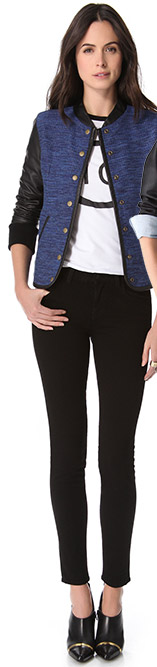
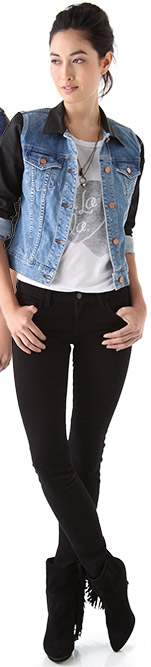
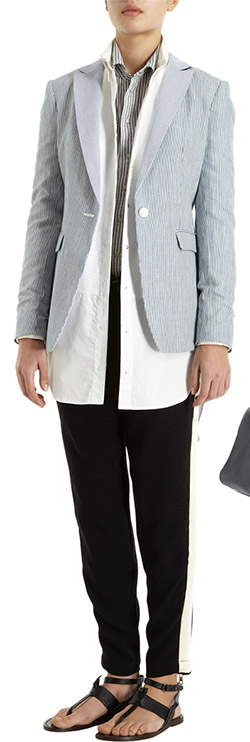
Formula: Blue Topper, White Layer and Black Bottoms

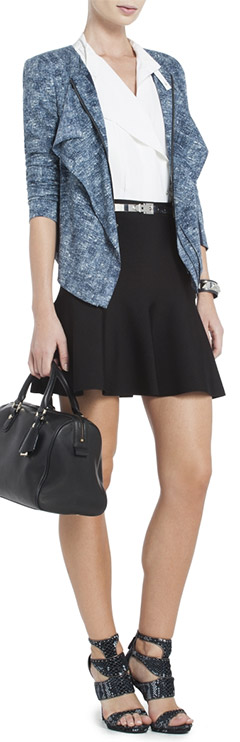
This might seem like an obvious outfit combination, but frequently my clients are stumped by blue toppers. First, some of them think that they can’t wear blue toppers with blue jeans. And second, they wonder which colour works best layered underneath blue. Well, of course you can wear blue toppers with blue denim! But if that feels like too much blue, black bottoms are the next easy solution. As for the under layer, you have countless options but a shade of white is a good way to go. 

Which brings me to the timeless combination of a blue topper, white layer and black bottoms. The pictures below illustrate the forumla, but let’s break it down by component.

Blue Topper

By topper I mean blazers, leather jackets, coats, denim jackets or sweater coats in any shade of blue. From ink blue and cobalt, to shades of French blue and light blue, and everything in between. The topper needn’t be completely solid. False plain tweeds, seersucker stripes, pinstripes and marbled patterns function much like a solid. On trend, mixed media two-toned toppers in black and blue work well here too.

White Layer

Any shade of white is fab, from optical white to bone and cream. Just choose the white that works for you. Think layering tees, shirts, blouses, knitted tops, or knitwear. Furthermore, no need to keep the layer a solid white. Some of the photos show white tees with grey and black panel prints. Or blouses with black collars. Or a stripe in a soft grey and white could make a good layering piece. 

Black Bottoms

Classic slacks, jeans, Ponte knit stretch pants, cigarette pants, culottes, slouchy pants, leather pants, harem pants, cropped pants, pencil skirts, flared skirts, long shorts, shorts shorts — you name it. Choose any style of black bottom.

You can swap the colours of the bottom and the layering piece around — white bottoms and a black layer — if that’s more your cup of tea. Blue toppers generally look stellar against a black layer, although you lose the lightness and crispness of the white. 

It’s easy to finish off the outfit with black footwear because it picks up the colour of the bottoms, and extends the length of the leg line if you’re wearing black jeans or pants. But white, cream, taupe, chestnut, metallic, or neutrally patterned footwear are more fab options. Accessorize to your taste and you’re done.