How to Build Your Wardrobe’s Colour Palette

There is no one correct way to build your wardrobe colour palette. Unless you’re in the very unusual situation of starting a wardrobe from scratch and building it all in one go, your palette will evolve organically over time through an intuitive process. That said, it is definitely worthwhile to give the colour palette of your wardrobe some thought so that the items work together to create cohesive outfits that make you feel fab.

Helping clients with their wardrobe palettes is a fascinating aspect of my work. I find that palettes differ quite a bit from one client to another, and seldom do they mirror my own. Over the years I’ve found that being in touch with the way colours make you feel, assessing your affinity for colour mixing, identifying your important neutrals and colours, and being deliberate when adding a new colour to your wardrobe, are all important parts of mastering your wardrobe palette.

Listen to Your Emotions 

The colour of a wardrobe item can make us feel happy, sad, confident, blah, serious, playful, powerful, weak, energetic, anxious or alluring. LISTEN to these emotions and make sure that the emotion associated with the colour of a particular wardrobe item is the right one. 

Do a little soul searching with colour because it’s not always as straightforward as it seems. You may love a colour in theory — like magenta — but feel off when wearing it as a wardrobe item. Or perhaps it’s a question of sporting a particular colour in the right smaller dose — like through an accessory. Explore how colours make you feel on a regular basis because this does change over time. 

Assess Your Affinity to Colour Mixing

The more willing you are to combine unexpected and clashing colours together in an outfit, the easier it is to manage a wardrobe with a large assortment of colour. 

In other words if your affinity for colour mixing is high, you’ll happily combine all sorts of weird and wonderful colours into an outfit and feel fab. Because you like wearing a wide assortment of colours and in unconventional combinations, you feel in control of a wardrobe that is steadily increasing in colour possibilities. This is not the case when your affinity for colour mixing is low. In this case a wardrobe full of colour will be overwhelming. The colour combinations that tickle your fancy will be narrower, so it will be a good idea to limit the range of colours in your wardrobe. 

Identify Your Favourite Neutrals

Identifying which neutrals work best for your complexion and style creates a foundation that can be mixed and matched with other neutrals and non-neutral colours.

It’s important to choose a range of neutrals — from dark to light — because some neutrals work better with non-neutrals than others. For example, whites and tans work particularly well with pastels. Dark neutrals work well with brights and jewel tones. And chocolate and cognac work well with earth tones.   

If you like to keep it very simple, choose a dark, mid-tone and light neutral as the backbone of your wardrobe. Stick to these neutrals and don’t add another unless you’re prepared to move out of your comfort zone when styling neutrals in outfits. 

Again, if your affinity for colour mixing is high, you’ll effectively build a wardrobe with a larger assortment of neutrals. For example, there is no need to choose between dark neutrals like black, chocolate, charcoal and ink blue when you like wearing them together in an outfit or styling them with a large range of non-neutrals. The same holds true for mid-tone and light neutrals. 

Identify Your Favourite Colours 

Most people also enjoy wearing a range of non-neutral colours, even if the range is very small. Identify the colours that work with your complexion and make those the permanent colours in your wardrobe. Having a dark, mid-tone and light neutral to work with them will increase the outfit combinations you can create. 

You might find that you wear colours seasonally, in which case you need to ensure that you have the right neutrals to support the wardrobe colour spectrum that changes with the seasons. 

In the rare instance that you ONLY wear neutrals, you can skip this step entirely. Building a wardrobe that consists solely of neutrals can be done if those are the only colours that create a positive emotion for you. 

Think in Capsules When Adding a New Colour 

It is inevitable that our style will evolve over time, and that is a good thing. It also means that you will be introducing new colours to your wardrobe from time to time. But you have to be mindful about how you’re going to integrate that new colour into your outfits. Ask yourself whether you already have the neutral and non-neutral items to wear with the new colour. If not, purchase the new colour with a support act. Perhaps you need to purchase more than one item in the new colour in order to create cohesive outfits.   

For example, a dark neutral and jewel tone-loving client of mine wanted to add blush to her wardrobe for Spring. In order to make the blush work well in outfits, she also needed to purchase a few more separates in white and blush, as well as tan and silver shoes and bag. Having invested in a support act of light neutrals, it opened the door to add new colours like mint and lilac quite effortlessly because they also worked well with the white, tan and silver.

As I mentioned at the outset, building the colour palette of your wardrobe can be intuitive, which means that some of you are following these steps without giving them a lot of thought. This is especially true for those who have a high affinity for colour mixing. 

Just when you have it all figured out, your colour preferences will change. And so the thought process starts all over again, making our wardrobes a perpetual work in progress.

Link Love: Lingerie Spotlight

After stumbling upon The Lingerie Addict’s post about their favourite brands of 2014 — check out those silk robes by Meng — I thought it would be fun to round up a few lingerie-related links this week:

Fab Links from Our Members

Joy would love to go see the Native Fashion Now exhibition that, with nearly 100 works, “celebrates the visual range, creative expression and political nuance of Native American fashion.”

Shevia thought the Denim: Fashion’s Frontier exhibit at the Museum at FIT looks interesting too.

Sally shares how to style sequins for the holidays. Subdued sparkle or all-out glam is up to you, Angie agrees, but above all have fun with your look!

Deb loved this Guardian article that asks if ironing is a thing of the past. Are you also a “domestic dissenter”?

Vildy enjoyed this interview with Brunello Cucinelli, in which the Italian fashion designer shares tips on how to wear pale colours.

Holiday Ensemble: The Cozy Party Frock

Nothing beats the simplicity of a dress. Pull it on, add footwear, hosiery, topper and clutch, and Bob’s your uncle. Of course the hardest part here is finding a frock that you like, and making sure that you don’t feel self-conscious about lumpage and bumpage. Not to mention that most of us want it to be adequately warm and cozy for this time of year. 

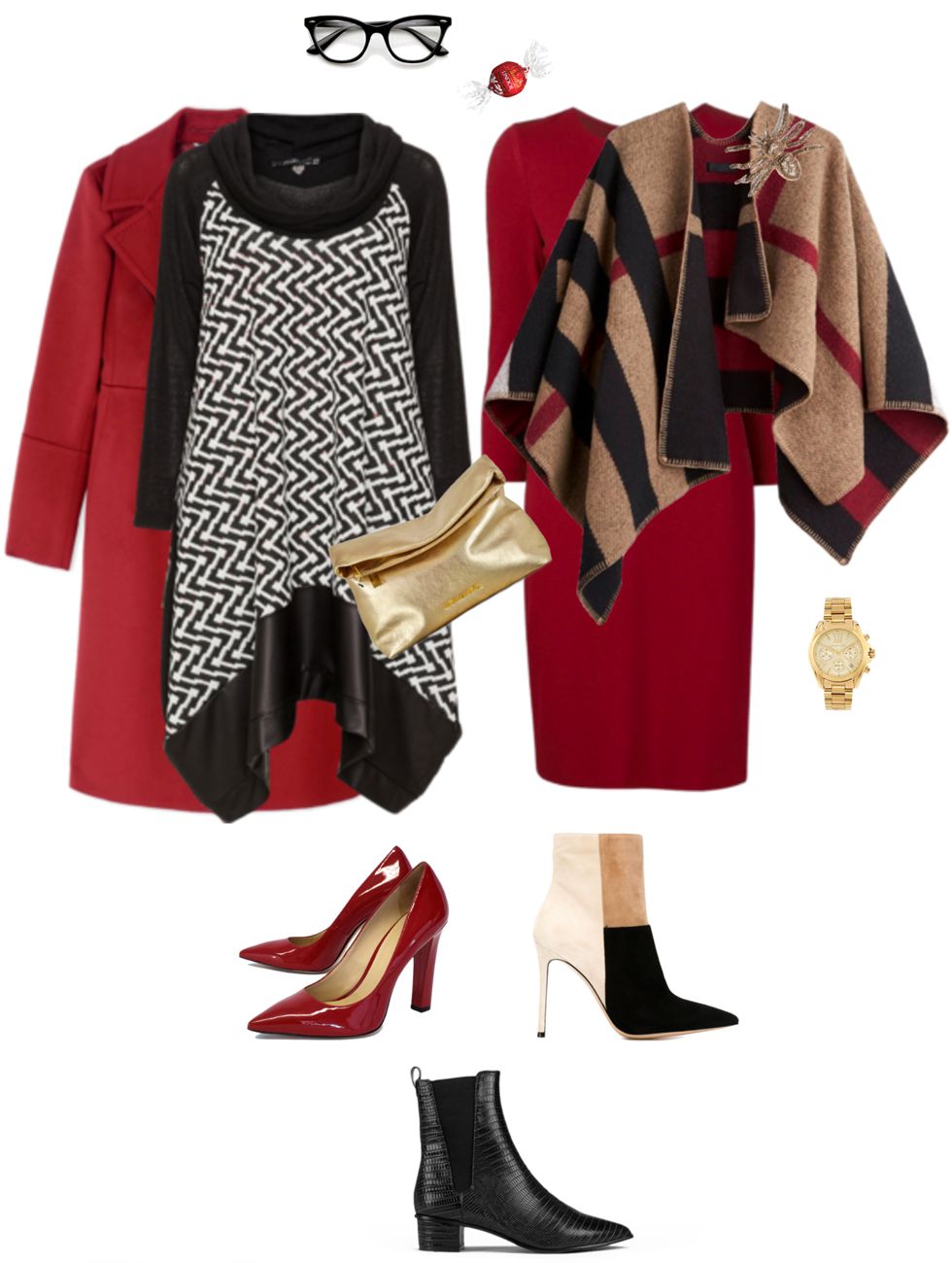
Knitted dresses in substantial fabrications, sweater dresses, A-line dresses with handkerchief hems, and sack dresses get my vote for maximum comfort. Make these styles of dress the base of your holiday look this year and finish them off with a festive touch. 

Here are two outfit formulas to get you started with the concept. In the spirit of being traditional, I’ve chosen a classic black, white, red, tan and gold palette. But you can choose any colour palette, as long as your footwear is festive. 

Sweater Dress & Coat

Combine a sweater dress with a fun coat. Fit-and-flares, sack silhouettes, and A-line sweater dresses are particularly comfortable. Add pumps, heeled booties or tall boots for footwear. Finish off the look with hose and sparkle. 

Sheath & Statement Wrap

Combine a simple sheath dress with a dramatic wrap or poncho. Choose a solid or patterned topper. The type of topper can stay on indoors so you don’t need to worry about losing outfit drama. Add pumps, heeled booties or dressy taller boots for footwear. Finish off the look with hose, sparkle and plenty of good cheer.

Holiday Ensemble: The Cozy Party Frock

Roundups

Simpler Items

This week's list of top picks list is about basic pieces.

Read More

Assorted Items

Items for Summer, both in and out of air conditioning.

Read More

Casual Summer Vibes

This week's top picks are good for a casual Summer vibe.

Read More

Summery Earth Tones

These items are for those who like to wear casual earth tones in warm and hot weather.

Read More

Hints of Spring

Some tried-and-tested winning items to refresh your style for Spring.

Read More

Dressier Items

An assortment of dressier top picks might be just what the doctor ordered.

Read More

Weekly Roundup: Blouses under $100

Some of these blouses can be insulated with thermal underwear to make them wearable in colder weather. Or they can be layered under a sweater or jacket. I’ve seen most of them in person and have fitted some on clients. Personally, I’m drawn to their soft and romantic vibe. Browse all the colour options. 

Visit the collection page to see the items alongside my descriptions.

How to Wear Blouses and Shirts in Cold Weather

My blouses and shirts don’t get much action for half the year because I much prefer wearing warm and cozy knitwear in the late Autumn, Winter and early Spring. But every so often, just to change things up, I will wear a blouse or shirt in the colder months as long as I can insulate them in a reasonable way. Granted, temperatures must be above freezing and toasty central heating is a must. 

These are the exact blouses and shirts from my wardrobe that I will wear in cold weather. They are long-sleeved, high-necked, opaque and covered. And in the case of the plaid shirt, brushed flannel is cozy against the skin and feels adequately Winter-y. 

Here’s how I insulate my blouses to stay warm:  

1. With Long-Sleeved Thermal Underwear

I’ve found Uniqlo’s Heattech thermal underwear to be best because it’s fitted, lightweight, extremely soft, and warm. Heat without the bulk. I will wear a long-sleeved, crew neck Heattech T-shirt in black or white under a shirt or blouse, and finish off the outfit with a coat for outdoors. Sometimes I’ll also layer a camisole under the Heattech tee. You can barely see the Heattech tee under the opaque blouse or shirt, which creates a more polished look. In this way you can sport “the blouse look” instead of “the sweater look” in cold weather. 

2. Layered Under Knitwear 

Wearing a shirt or blouse under a pullover or cardigan is another way to insulate the item indoors. It creates a fun look when the collar, cuffs and shirt tail of the blouse or shirt are peeking out from under the pullover (or upscale sweatshirt for an athleisure vibe). For further insulation, I will also wear a camisole or Heattech tee under this combination. Top off the look with a wool coat and I’m good to go.

I run cold so it’s important that I insulate under and over blouses and shirts in cold weather with the right pieces. But some of my clients don’t bother because they run much warmer than I do. They will happily wear a sleeveless blouse year round without a camisole — forget the Heattech — and simply layer a jacket or cardigan over the top. It is hard for me to understand how they manage this in the dead of Winter without feeling cold, but they do. They might pop a coat on if they’re outside for any length of time. In some cases, these clients are worried about overheating when wearing knitwear indoors, which means that they need the option of removing layers and wearing light layers to be comfortable.

Over to you. Do you wear shirts and blouses in cold weather, and if so, how do you insulate them?