12 Tips for Feeling Fab in White Bottoms

Black jeans or trousers are visually slimming. They camouflage lumps and bumps and extend your long lean line when paired with dark footwear. Conversely, white jeans and trousers tend to have a widening effect and aren’t quite as forgiving with lumps and bumps. Does this mean you should ban white bottoms from your wardrobe?

My answer to that question is an emphatic “no!” You do NOT need to be tall, thin, long in the leg, or slim to wear white bottoms. Almost all of my clients, who span a size range of 00P to 22, wear white bottoms. This includes all body types and covers a wide range of ages.

As always, it’s how you wear the item that counts. If you’re battling with the concept of light coloured bottoms, here are twelve tips that might help you to feel fab when wearing them. 

  1. Choose denim or thick fabrications: They provide more structure and coverage than thinner fabrications thereby streamlining the silhouette and camouflaging lumps and bumps. 
  2. Choose wide silhouettes in thin fabrications: If lightweight fabrics are essential to combat the heat, choose them in relaxed styles, like wide leg linen pants, or cotton harem pants. That way the fabric stands away from the body and does not cling or look transparent.
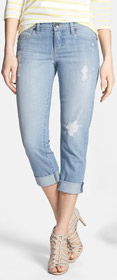
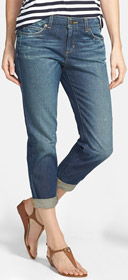
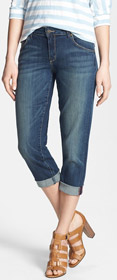
  3. Wear white boyfriend jeans: Here we have a looser silhouette and a thicker fabrication, providing coverage, structure, and effective camouflage for wobbly bits. 
  4. Size Up: White bottoms can be revealing, so sizing up to create a looser fit on a structured style is a good idea. 
  5. Pay attention to pocket detailing: It’s annoying when the pocket linings of white bottoms shine through. One option is to choose a style without side entry pockets. Failing that, pocket linings can be cut out by a competent tailor. Pocket linings are usually less visible on thicker fabrications like denim, and on wider, looser styles. 
  6. Wear Tunics: A little extra coverage on top can make all the difference. Wear longer tops if you’re self conscious about exposing your hip and thigh area in white bottoms. 
  7. Create slouch by partially tucking roomier tops: Create a little blousoned slouch with a fluid or oversized top by semi or faux tucking into white jeans or trousers. The volume of the larger top visually narrows the bottom, while the partial tuck creates the required structure. 
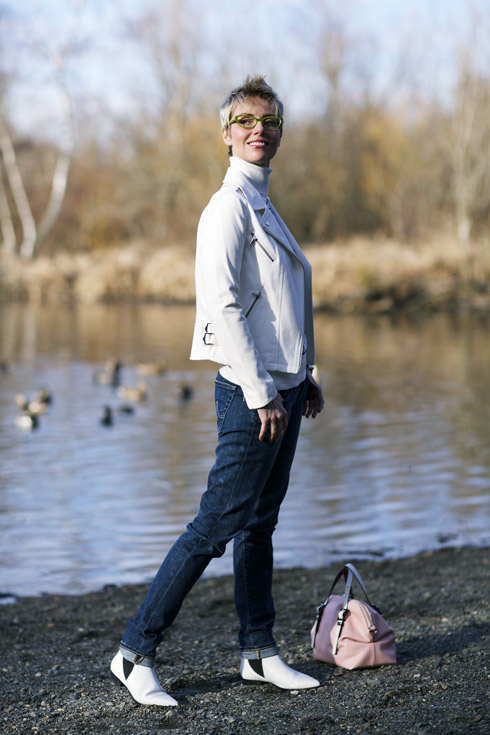
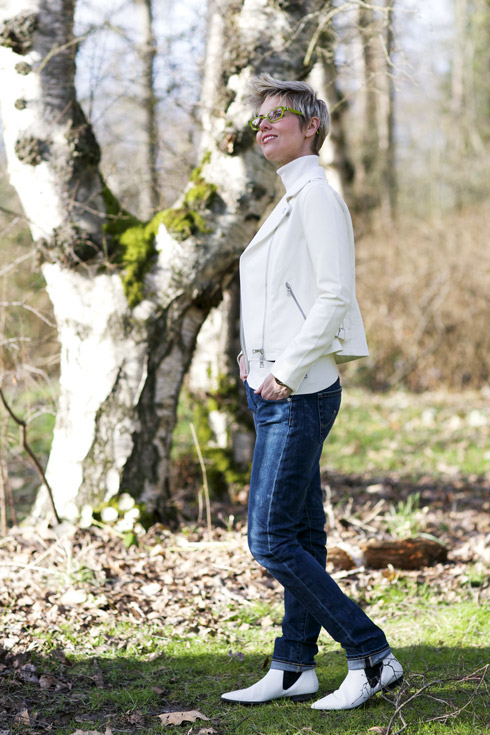
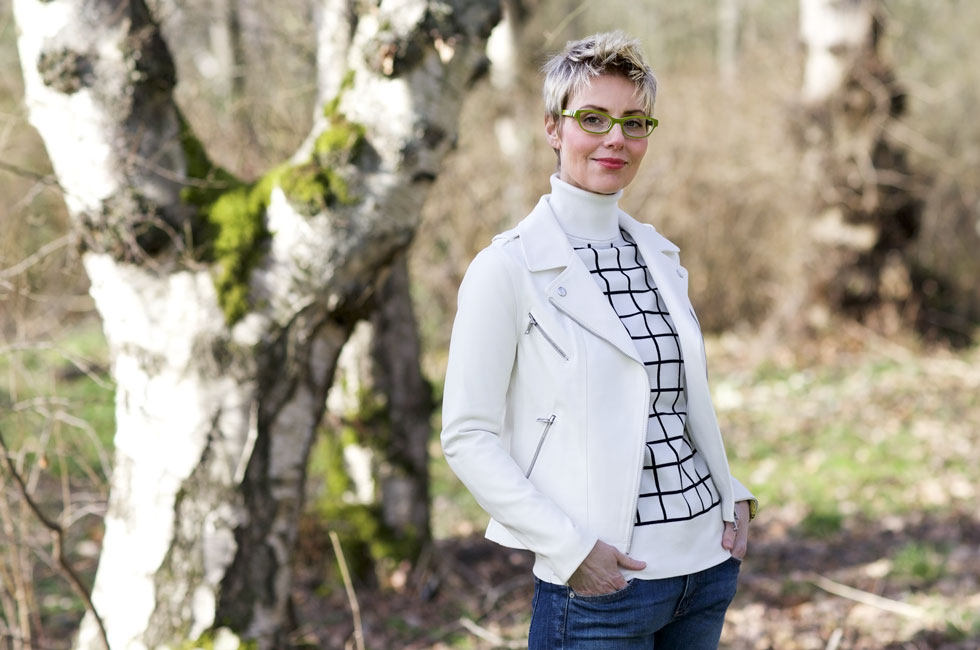
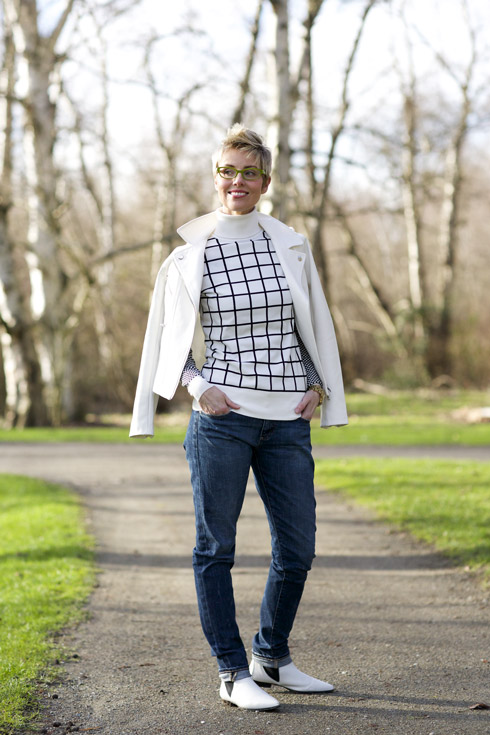
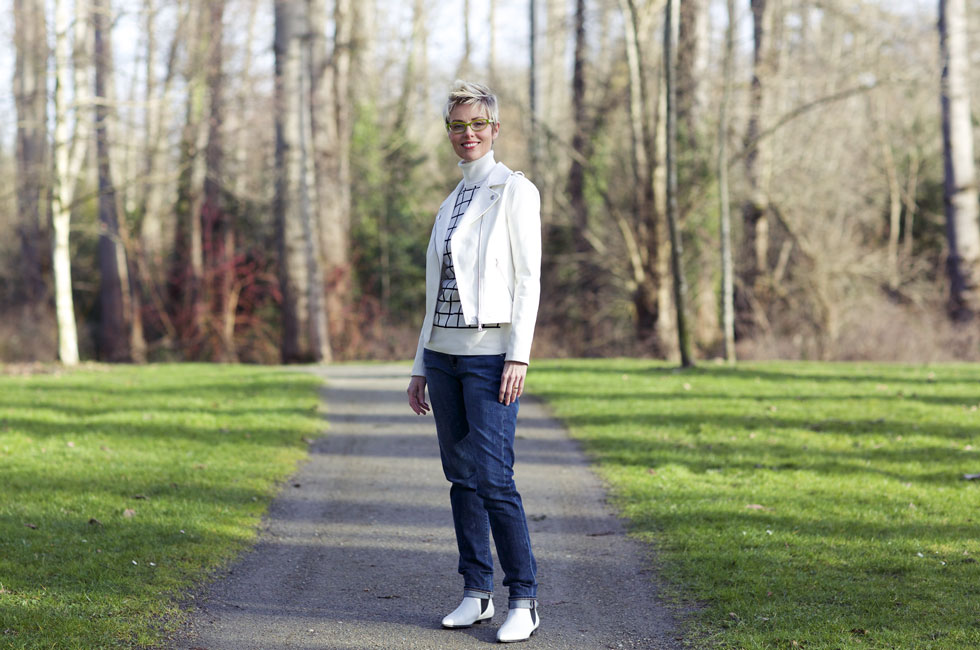
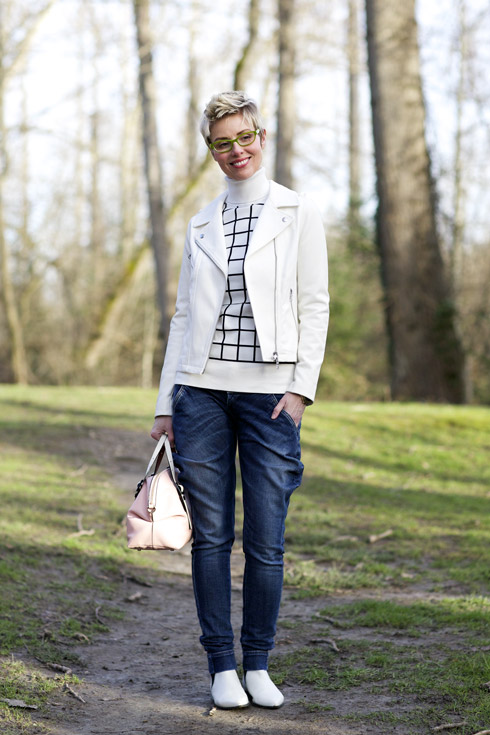
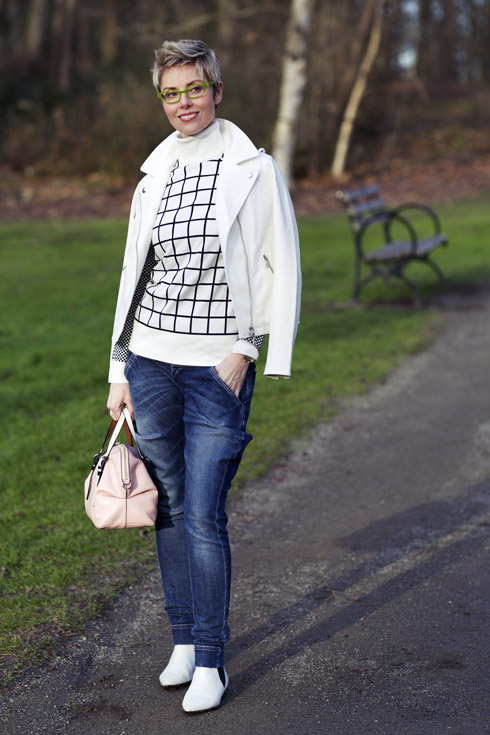
  8. Create a white column of colourColumns of colour are visually slimming and elongating. In this case it means wearing a white top with white bottoms under a topper, thereby creating a column of white.
  9. Wear heels to elongate the leg line: This is especially effective with wide hem bottoms and while sporting perfect pants lengths (no shorter than a quarter of an inch off the ground). It’s also great to wear heels with tapered leg silhouettes. 
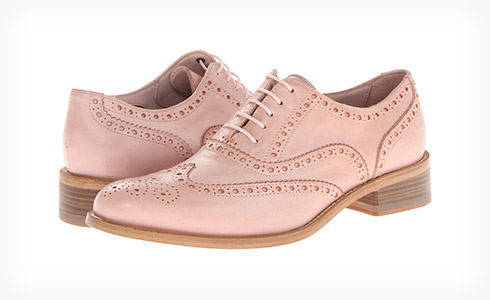
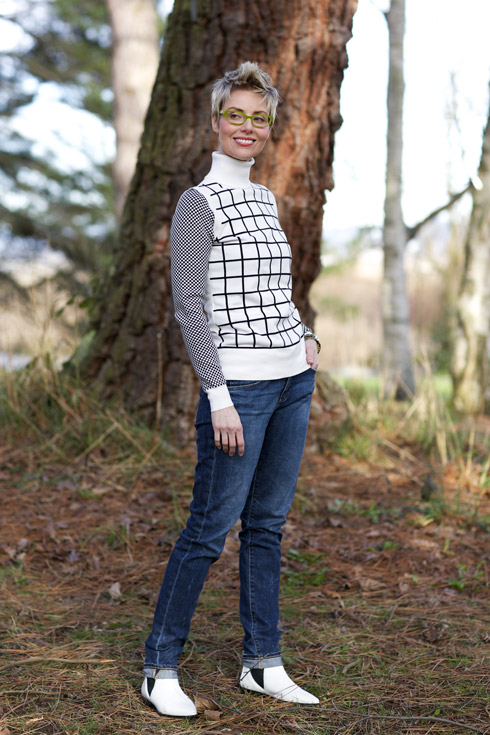
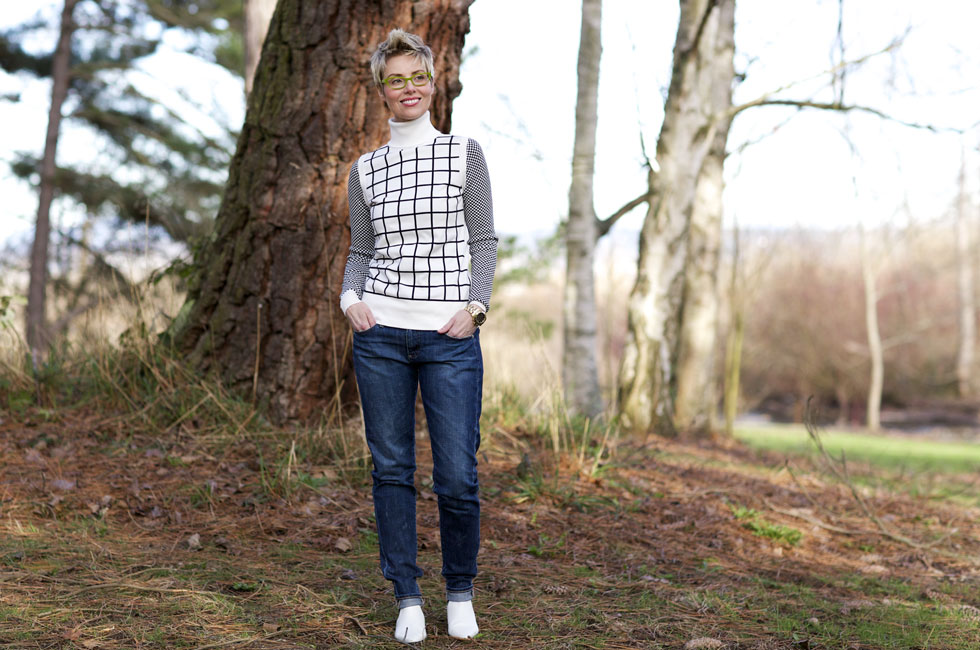
  10. Further elongate the leg line with white footwear: Wearing white shoes with long white jeans and trousers is flattering because the shoe looks like an extension of the bottoms, thereby creating a visually longer leg line. Pointy toe flats are a great way to lengthen the leg line if heels aren’t your thing. 
  11. Wear flesh toned undies: White bottoms are usually more transparent than dark colours, which means that showcasing undies is a problem. Wear solid nude-for-you undies to prevent them from shining through. 
  12. Forget about looking your slimmest: Wear white bottoms because you love their crisp, bright and modern effect. There is more to making you feel happy in an outfit than looking your slimmest and tallest. 

You also have the option of sporting white dresses and skirts if jeans, pants and shorts aren’t your thing. Dresses are built-in columns of colour, and flowing white skirts are lovely with a fluid or structured top. 

White jeans are a wardrobe essential for my style, and I wear them year round. I also love wearing cream jeans, trousers, and an A-line skirt. Sure, I look slimmer in a pair of dark bottoms, but wearing white bottoms makes me happy, and that trumps it all.

Rachel Roy Top & Skinny JeansSplendid Sweater, Tee & Paige Denim Jeans

Vince Tunic Dress & Skinny Jeans

Chelsea28 Top and PantsLafayette 148 New York Topper, Sweater & Jeans

Chelsea28 Coat, Pullover& Pants

Fashion News Roundup: Week 6, 2014

Orla Kiely teams up with Clarks, two more fashion collaborations, Pantone’s new Fashion Colour Report and more news from the world of style. 

Fun Fashion Fact

Marimekko’s trademark Unikko poppy pattern is celebrating its 50th birthday this year. Did you know that Marimekko is Finnish for “Mary’s little dress”?

Ensemble: Olive and Pink

This outfit formula is about mixing shades of olive with shades of pink. Olive can be light or dark, and is pretty earthy. I’ve also added chartreuse to the ensemble because to my mind, chartreuse is like a brighter and more sour version of olive. Think any shade of pink when mixing it with tones of olive. From the prettiest pale pink and blush, to mid-tones, shocking pink, neon and fuchsia. 

I kept black out of the formula and used shades of brown for neutrals. From chocolate and cognac, to taupe and tan. Combining shades of white as neutrals will also work. Of course, black footwear is an easy bookending substitution when you have black hair.

Here are the components. There’s a dressier outfit on the left and a more casual rendition on the right.

Bottoms: Think jeans, dressy trousers, cropped pants, casual pants, or a skirt in a shade of olive. By all means throw in camouflage print, a pinstripe, jacquard, subtle self-colour pattern, or false plain. 

Tops: Think knitwear, upscale sweatshirts, shirts, blouses, knitted tops, peplums, crop tops and tees, in any shade of pink. Make sure the top works with the bottoms you’ve selected. I like both bright and softer pinks with olive. Belts are optional. Wear one that matches the colour of the top, bottom, footwear or bag. 

Toppers: The style of topper depends on the outfit and climate. Blazers, motos, wool coats, trench coats, cropped jackets, cocoon styles, drapey styles, anything at all. 

There are many options for topper colour. Keep it pink to match the pink of the top. Wear a topper in olive (the olives in the outfit do not need to be the same.) Throw in a chartreuse topper because it’s a bright form of olive and complements the pink. Dark brown, tan and taupe toppers work too. Or choose a topper in a shade of white. 

Footwear: A shade of brown is an easy match, as is black to bookend black hair. Lighter neutrals like taupe, tan and white are pretty. And don’t forget the versatility of metallics. 

Accessories: Brown, taupe, tan and white bags are great, and feel free to match them to the colour of your shoes. Metallics are another option. A blush bag is fab if you’re wearing a lighter or darker shade of pink on top. An olive bag will work too. Throw in a scarf that picks up some of the colours of the outfit, or wear one that’s tonal with the top. Finish off the outfit with jewellery, watch, hat and eyewear as desired. 

Ensemble: Olive & Pink

Feel free to turn the formula upside down by sporting pink on the bottom and olive on top. 

We’re used to matching pink with grey, which is a classic combination. Why not sport pink with olive and grey, which is why I added the silver oxford into the ensemble. Of course, metallics are neutrals and gold will work too. 

Roundups

Simpler Items

This week's list of top picks list is about basic pieces.

Read More

Assorted Items

Items for Summer, both in and out of air conditioning.

Read More

Casual Summer Vibes

This week's top picks are good for a casual Summer vibe.

Read More

Summery Earth Tones

These items are for those who like to wear casual earth tones in warm and hot weather.

Read More

Hints of Spring

Some tried-and-tested winning items to refresh your style for Spring.

Read More

Dressier Items

An assortment of dressier top picks might be just what the doctor ordered.

Read More

Link Love: New York Fashion Week Kicks Off

New York Fashion Week starts today. For the next eight days, designers will be showing their Fall/Winter 2014 collections. If you’re watching the shows from your comfy chair and would like a bit of background info, here are some fun reads:

Fab Links from Our Members

Ingunn would like to share this article about the history of Shetland and Fair Isle sweaters. As a knitter, she is deeply intrigued by the intricate patterns and colours.

Joy found this Wall Street Journal article about knitwear care very informative. It’s extra fun because stylish YLF member CocoLion (Denise) was interviewed for the article! (subscription only)

Neel found “The 50 Wildest, Most Torturous Shoes of All Time” a very painful and depressing read. Why do we women go to such extremes to showcase our beauty?, she asks.

Nancylee informs us that Nordstrom has teamed up with Etsy to feature a selection of unique items from emerging artists.

Deb said that Downton Abbey’s Lady Edith must be reading YLF as her style is a-changing. She enjoyed The New York times discussing her changing dress and attitude. Lyn* in the meantime discovered that you can rent a replica of Lady Mary’s wedding tiara.

MuseumGal loved this article about Judi Dench’s style, sort of grown-up boho.

Shevia enjoyed Jezebel’s roundup on Cathy Horyn, the fashion critic who announced her retirement from the NYTimes last week.

The wardrobe diagnostics post on Into Mind is helping La Belle Demimondaine to get an even better handle on her wardrobe and current style goals.

Karie found this article very interesting. It explains how Nordstrom responded to a complaint from a customer who had concerns about the “Skinny Sleep” pillow on offer in the stores.

April loved the way Allie used metallic oxfords in this outfit post.

For those who appreciate the art and history of bespoke tailoring, HiggsMistress recommends “The Coat Route: Craft, Luxury & Obsession on the Trail of a $50,000 Coat” by Meg Lukens Noonan.

Angie enjoyed Catherine’s take on why short wedding dresses are stylish and affordable. A fun and refreshing silhouette for when you walk down the aisle. 

TraceyLiz had fun taking the style type test over at A Beautiful Little Life. She already knew she had a slight bohemian touch to her style, but the test revealed an overwhelmingly whimsical style. 

LACeleste thought that novelist Diane Johnson’s essay about remembering those who help us with our style journeys was very nice.

It’s your own perspective of how you look at yourself.” Vildy found this video interview with designer goldsmith Annette Gabbedey, who was born without fingers, quite fasincating.

Suja loved this article and the comments about the Casual Couture of the Average American.

L’Abeille points us in the direction of this historical overview about Eleanor Lambert, the woman who brought us New York Fashion Week.

Vicki wants to share this entertaining piece on the power suits worn in the movie “The Wolf of Wall Street” and how women choose to wear them today.

Lisa thinks it’s refreshing to come across a blog with traditional office style. She especially liked Mary’s outfit with loose trousers, top and flats.

How to Dress the Inverted Triangle Body Type

It’s back to first principles as I update the body type dressing guidelines in the context of current fashion trends. If you’re unsure of your body type, or new to the concept of body types, then you might want to read my refresher on identifying your body type before tackling this post on the inverted triangle.

Three important points before I begin: 

  1. These are guidelines, not rules: The information here should be viewed as a helpful starting point when you’re unsure about how to create conventionally flattering and balanced proportions for your shape. Everyone has different figure flattery priorities and sometimes the most stylish outfits ignore the guidelines completely.
  2. The guidelines are general: My philosophy is to define a few simple body types and then be flexible when working with them. Most of us are a mixture of a few body types and don’t look exactly like one of the 5 prototypical shapes. Filter through the information and use the parts that make sense for your shape. 
  3. There is one rule to keep in mind: Have fun with fashion. 

You are an inverted triangle when the top part of your body is larger than the bottom. You usually wear a larger size on top than on the bottom, have relatively broad shoulders, narrower hips and slender limbs. Some inverted triangles have a straight waist and flat bottom, whereas others have a defined waist and curvier bottom. Bust size can vary.

Softening the shoulder line and creating a balanced silhouette so that you don’t look top-heavy is what you’ll need to think about most. Creating curvature on the bottom is next, and defining the waist is optional. In fact, surrendering the waist is a great look because it marries the width variance between the top and bottom parts of the body more gradually. The severity of a defined waist can make you look like you’re toppling over. That said, a little waist definition is a better idea when you have a very full bust. 

Softening the Shoulders

  • Make sure you’re wearing the best bra to create curves in all the right places. Lift the girls and smooth out the midsection. 
  • Tops made of soft knits and wovens are best because their superior drape de-emphasizes the shoulder line while the excess volume collapses back onto the body providing a little structure. 
  • Tops in stiff fabrications like button-down shirts are harder to pull off, but not impossible when you wear them with enough ease through the shoulder, a little stretch, and open at the collar to create a V-shape effect. 
  • Tops with low and/or open necklines are your friend, especially when you have a larger bust and shorter neck. Think high or low scoop necks, cowls, drape necks, boat necks, open shirt collars and V-necks. Stay away from high necklines like turtles and funnels unless you have a very long neck. Crew necks are fine.  
  • Dropped shoulder seam tops will work when the fabrics are soft, the sleeves are tailored, the torso slightly defined, and the neckline open. 
  • Dolman sleeves with waist definition and an open neckline are best. 
  • Avoid shoulder details that visually accentuate width, like epaulettes, puffy sleeves, shoulder ruching, flutter sleeves, extended shoulder pad detailing, and a high-contrast colour block across the shoulder area. 
  • If you enjoy showcasing your arms and shoulders, wear strapless style tops and dresses.
  • Stay away from hard and rigid fabrications unless the items are tailored and very structured. 
  • Keeping cardigans V-neck and unbuttoned softens the shoulder lines.
  • Raglan sleeves have a magical way of narrowing wider shoulders, and widening narrow shoulders. Make sure that the neckline is open to visually shorten the width of the shoulder line.
  • You were made for collarless jackets and blouses, especially when you have a short neck, because your shoulders provide ample structure to carry the silhouette. 
  • Bold horizontal lines have a widening effect so if you’re going to wear horizontal stripes, keep them subtle and monochromatic.
  • Beware of bold and large patterns on top in general because they have a widening effect.
  • Keep the lapels on jackets and coats small or mid size and relatively refined, because oversized collars and lapels tend to make shoulders look broader. 
  • Jackets, in any style, that are structured on the shoulder with an inset sleeve are best because they shorten the width of the shoulder line.
  • Jackets with stretch, or inset stretch panels on the sleeves are more comfortable because they’ll give your shoulders extra room. 
  • Fine gauge knits are best because they aren’t bulky. Opt for semi-chunky styles if you prefer warmer and more substantial sweaters. Chunky knits work in darker colours and in structured silhouettes with a more open neckline. 
  • Shirts, jackets, tops, blouses, coats and dresses with vertical seaming are ideal. Think princess seaming, pintucks, side ruching detailing, side paneling, and top stitching. Also, the vertical line that is created in front of the body by keeping a tailored jacket open, is slimming and flattering.
  • Wearing darker colours on top and lighter colours on the bottom helps to visually create balance by narrowing the top and widening the bottom. 

Creating Curvature at the Bottom

  • Narrow hips and slim legs give you tremendous choice when it comes to pants, shorts and cropped styles. By all means sport extra volume on the bottom. In fact, it’s my favourite look on an inverted triangle. Think bootcuts, bell bottoms, culottes, wide leg pants, harem pants, trouser jeans, boyfriend styles, slouchy track pants, pleated slouchy styles and cargo pants.  
  • Straight legs, relaxed skinnies or cigarette styles tend to look better than skinny styles and jeggings because they balance out your top half. 
  • Wearing bold patterns and colours on the bottom is no problem. 
  • Trousers can be altered at the side seams and on the seat if they’re perpetually baggy in that area in order to fit on the waistline. 
  • Pencil skirts that are extra tapered at the hem create a curve on the hips that works well for some straight-waisted inverted triangles. On the other hand, inverted triangles with a large bust and shoulder line, and extra narrow hips, look great in pencil skirts with side seams that drop down straight from the waist instead of tapering in towards the knee. This creates a bit of volume to match the top part of the body.
  • Knee-length skirts with contoured waistbands, patch pockets on the front or back are good. Full circle, tiered, softly pleated or paneled skirts, bias-cut skirts, sarongs, and skirts with stitched down pleats are also excellent. 

Surrendering the Waistline

  • If you are an inverted triangle with a straight waist and regular sized or small bust, you wear soft voluminous clothing that collapses back onto the body really well because angular bodies flatter straight styles. But add a little structure to this unstructured look by sporting high-low hemlines, tops with welts, and long tailored sleeves. Wide sleeves work when they are cropped to three quarter lengths. 
  • If you’re an inverted triangle with a defined waist and fuller bust, you can still wear waistless shift dresses and tops. If the styles are straight at the hem or gently A-line in silhouette, structured in the shoulders with a scooped neckline, fairly short in length, and made of soft drapey fabrics, chances are high that they will work. 
  • Jackets in fluid and oversized fits, which includes avant-garde drapey styles, are great when they’re structured on the shoulder and bust area. Jackets with longer curved hems add excellent vertical integrity. Keep the neckline and stance fairly low and opt for one or two buttons on a blazer. Pair the look with sleeker bottoms for a streamlined look, but by all means wear voluminous bottoms to create width on the bottom. If you have a shorter leg line, tuck in the top and add heels to the outfit. 

Defining your Waist

  • Defining the waist by wearing tailored clothing is a timeless and slimming approach to dressing, so by all means go this route if that tickles your fancy. But in the same breath I’ll say that surrendering the waistline by wearing fluid and oversized fits that float away from the midsection are a lot more flattering for inverted triangles who also tend towards an apple body shape. 
  • You can wear tops with ruffles, pleating and funky detailing, but be careful with their placement. Wrap tops and mock wraps are your friend because they create a V on the neckline and tailor the midriff.
  • The length of untucked tops should either catch you just below your hipbone or a few inches above crotch point when you wear jeans or pants. Crop tops and knitwear are tricky because they add bulk on top. But they can be successfully worn with skirts or layered over a longer layer, especially when you have a long neck. 
  • Layering structured jackets over soft and fluid tops provides a great unstructured-structure look.
  • You can wear most lengths of structured jacket if they are adequately nipped in at the waist for shape.
  • Keep the stance low to create balance between the waist and shoulder line.
  • Tailored sheath dresses — with or without sleeves — and bias-cut dresses worn at the knee are fabulous options. Soft dresses with V-necks, A-lines, wrap dresses, fit-and-flares and shirt dresses will also work. 
  • Defining the waist with a belt works well over soft fabrics. 
  • Semi tucking and faux tucking are great ways to sport a little waist definition and structure when you’re actually surrendering your waistline. 

Two more general dressing tips: Wear a column of colour under a topper to create a long lean line that is extra slimming. Wear higher rises, styles that float away from the midriff, structured jackets over fluid tops, and textured fabrics to avoid muffin top.

Feel free to share further tips on how to flatter the inverted triangular shaped body type in the comments section. Or if there are extra questions on how to wear particular looks and current fashion trends when you’re an inverted triangle, please ask below and we’ll get you sorted.