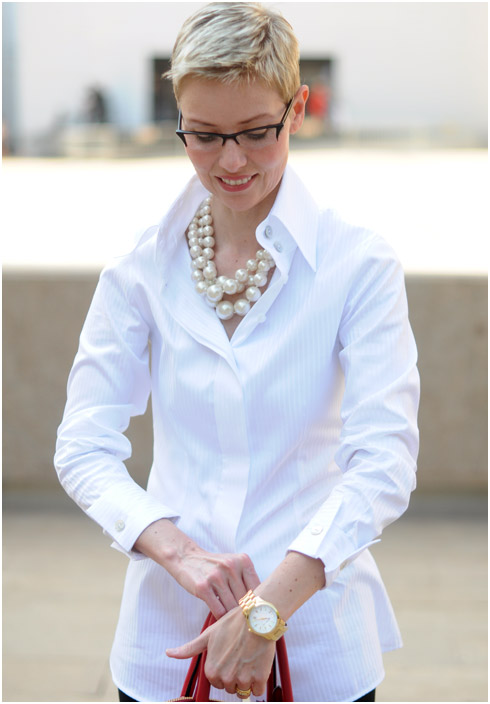
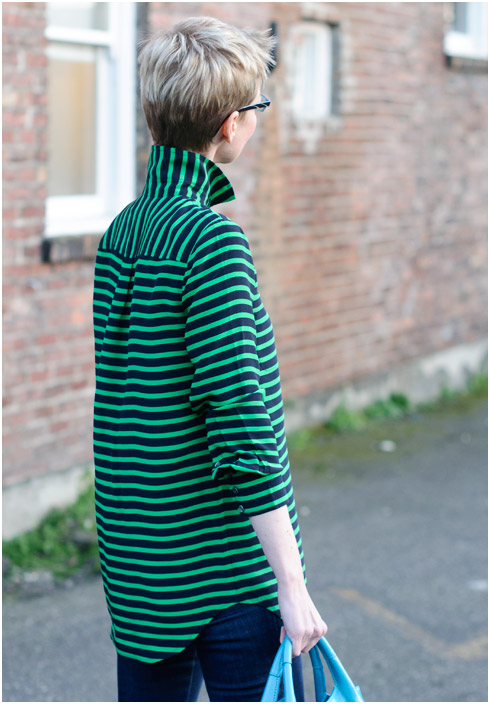
Two Elegant Tunic and Shorts Ensembles

I’m in the minority with my preference for tapered Bermuda shorts. In my experience most women prefer the length shorter like real shorts (mid thigh length), or stick to wearing pants cropped a few inches above the ankle. I like tapered shorts to finish “around the knee”, give or take a few inches below or above the knee cap. To my eye, this length looks balanced, proportioned, elegant and flattering. 

As the weather warms up, I am excited to wear my tapered Bermuda shorts (which I also refer to as clamdiggers). I have them in an assortment of blue denim washes, white and black. The silhouette works particularly well with a dressy soft tunic top. 

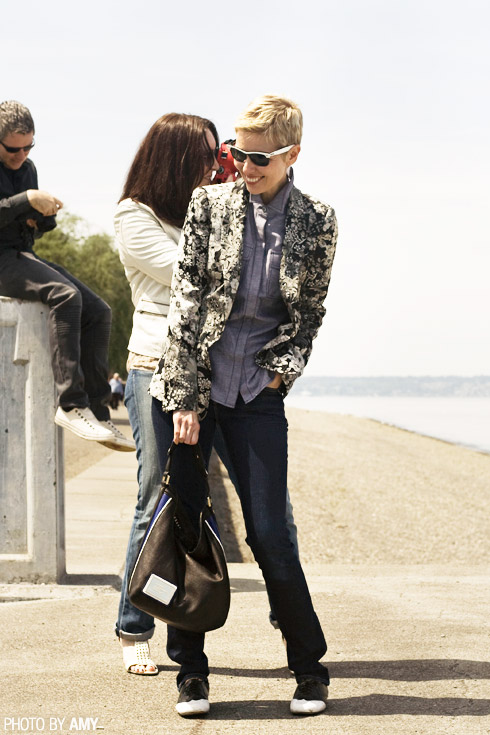
The outfit formula here speaks for itself and you can choose any colour palette. Match tapered Bermuda shorts with a soft tunic blouse, printed or solid. Swap out the Bermudas for slim fit cropped pants if that is more to your taste. Add a fairy dressy shoe, like a a wedge sandal or t-strap sandal. Dressy flats work just as well. Add in a statement handbag, eyewear and jewelry as desired. Easy, comfortable, practical and chic. 

Wear this outfit in smart-ish casual settings. Perhaps for casual Friday at work, when you’re out and about town, date night, sight seeing, or hosting a casual dinner party.

Summer Tunic & Denim

Earthy Tunic & Bermudas

Linen: Making Peace with the Crease

Woven linen items are breathable and warm weather friendly. They also look gorgeously relaxed in an unexpectedly sophisticated way. Yet woven linen clothing creases, and creases and creases, all day long. 

If you wear woven linen clothing, you have to be at peace with these creases and accept them as part of the look. The creases do in a strange way also have their appeal. I love linen shirts (the J. Crew example shown here), linen jackets and linen scarves, and have worn them throughout my adult life. I will happily wear those linen items again, paired with items that look extra crisp and do not crease. One crazily creased item per outfit is enough for me, and only on the top part of my body. Although I’ve worn linen trousers, shorts, skirts and dresses in the past, I don’t want to wear them again. These days I am less tolerant of crazy creasing on my bottom half. 

Linen knitwear like pullovers and cardigans seem to crease in a more forgiving way than their woven buddies. I really like the look of breezy and slubby linen knitwear but have yet to purchase a piece. The extra casual integrity always seems to stop me from making that final purchase. Yet I have no problem purchasing a linen button down shirt. I guess the structure of a shirt makes it more crisp than an item of knitwear. 

Wearing sleeved linen tops is another way to stay cool and covered. I remember how my late Mum liked to wear lightweight cotton and linen shirts or knitwear with rolled up sleeves in hectic Hong Kong and Cape Town heat. She maintained that she needed covering protection from the sun no matter what, and that’s why she did not like to wear sleeveless items. 

Do you wear linen pieces? If so, which linen pieces do you like the most? Do you like the look but loathe the high crease quotient? Or do you not care for linen at all? 

Wardrobe Capsules 101

I often mention wardrobe capsules. Recently I wrote about how to build a professional capsule for less, and how to create a work wear capsule for Spring. But I haven’t talked about the basics for some time, so here’s a quick rundown of what I mean by “wardrobe capsule” and how using the concept can help you to maximize the wearability of items, eliminate wardrobe holes, and ensure that you always have multiple outfits “ready to go”. 

My definition of a wardrobe capsule is broad and simple. It is ANY collection of clothing, footwear and accessories that helps you to satisfy your dressing needs in one or more areas of your life.

Your wardrobe capsules should serve your dressing needs and priorities. For example, if you are very focused on your professional life, build a series of capsules for work, and create a single capsule for the weekend. Then focus additional capsules on other areas of your life. Build a date-night capsule, a theatre capsule, a rainy-weather capsule, a Saturday ball game capsule, a sight-seeing in the city capsule, a work out capsule, a coat capsule, a beach capsule, and a cocktail dress capsule. 

Mix and Match Capsules

Often a wardrobe capsule is a group of items that can be mixed and matched with each other. Mix and match possibilities can make for a far more efficient and versatile wardrobe. To illustrate the power of this, consider a simplistic wardrobe with 10 tops and 10 bottoms. If each top only works with one bottom, then this wardrobe supports 10 good outfits. If every top works with every bottom, it will support 100 good outfits. Now, having every top work with every bottom is obviously un unrealistic goal, but having forethought and paying attention to mix and match possibilities will get you closer. 

I find that many women don’t even aim for mix and match versatility because at some point it gets too hard to think about how a new item fits into the context of their existing wardrobe. That’s where capsules come in. Instead of having to keep your entire wardrobe in your head, you can think about one capsule at a time. 

Other Capsules

Generally mix and match capsules are dedicated to a particular aspect of your life, like your work or your hobby. But there are also other capsules that are not about mixing matching at all. In this case the capsule helps you to identify and meet a particular need. A good example is a coat capsule. Here you need to make sure you have a small number of coats that meet your weather requirements, so it is useful to think about them independently of other items. Since many people can’t afford to have a coat of each type for every mix and match capsule, they need to ensure that each of their coats is versatile enough to serve many other capsules.

One item can be used across multiple capsules. For example, a business casual red blazer that works well for work with a pair of dressy trousers and pencil skirt, might work as well over the weekend with a pair of faded jeans and heels. Pop the blazer into both capsules and it’s become even more of a wardrobe workhorse. 

Keep the wardrobe capsules in your head as you edit your closet, prep a shopping list, and add items to your wardrobe. Before you make a purchase, take a moment to think about whether the item fits into an existing capsule, multiple capsules, or whether it represents a new capsule that you are starting from scratch. 

Capsules are the foundation of an organized wardrobe approach that will help you to make more informed purchasing decisions and will eleviate a lot of dressing stress. You’ll never have a closet full of items and nothing to wear. It is an extra effort in the beginning, but this investment will soon begin to pay off. 

Roundups

Simpler Items

This week's list of top picks list is about basic pieces.

Read More

Assorted Items

Items for Summer, both in and out of air conditioning.

Read More

Casual Summer Vibes

This week's top picks are good for a casual Summer vibe.

Read More

Summery Earth Tones

These items are for those who like to wear casual earth tones in warm and hot weather.

Read More

Hints of Spring

Some tried-and-tested winning items to refresh your style for Spring.

Read More

Dressier Items

An assortment of dressier top picks might be just what the doctor ordered.

Read More

Book Nook: How to Do Vintage

Clare Bridge and Jo Waterhouse wrote Wearable Vintage Fashion for everyone who wants to go all out and do a head-to-toe vintage look. This hands-on style guide shows you how to recreate quintessential looks from the 1920s to 1980s on a budget. Intro sections describe the silhouettes and trends of each decade. Next, get inspiration from lookbooks and day and evening wear pages filled with clothing and accessories from the author’s boutique. The “Get the look” and “Icon” sections help you put together vintage outfits based on old family photos and interpret signature looks of movie stars and style icons. Street style pictures of fashion bloggers and retro enthusiasts further showcase how to do vintage in modern day life.

If you prefer to limit the retro effect to one or two pieces per outfit instead, then Vintage Fashion Accessories might be a good fit for you. How to use unique vintage items to make a modern fashion statement? Where to find one of a kind period pieces? What is a fair price to pay? Author and owner of Incogneeto boutique, Stacy LoAlbo, answers all these questions and more in her first book – a style guide that also includes a history of fashion accessories. With more than 1000 colour photographs, personal stories, and chapters on hats, handbags, jewellery, shoes, compacts and carryalls, and vintage accessories for men.

Are you a fan of vintage accessories? Would you consider sporting a head-to-toe vintage look in everyday life? What do you think is the secret to pulling it off without looking a bit too costume-y?

Now in YLF Book Club

Genevieve Antoine Dariaux, for years the directrice of the Nina Ricci salsons, wrote down her views on timeless elegance in 1964. Today we are talking about her book, A Guide to Elegance – For Every Woman Who Wants to Be Well and Properly Dressed on All Occasions, in YLF Book Club. How much of Madame Dariaux’s advice still holds true for you today? Is striving for elegance one of your style goals? Join the conversation on the forum and let us know what you think of this retro style guide.

Quick reminder: On the Book Club page you can find the schedule of previous, current and future Book Club titles.

Related Books

If the titles in today’s Book Nook are your cup of tea, you may also like:


The Ryokan Experience

We stayed in a Western style hotel in Yokohama, but chose a Japanese style inn called a ryokan in Kyoto. Tomoko kindly booked us into “Ryokan Ginkaku” from Tokyo, and our experience was priceless. 

The ryokan room has a tatami mat floor, rice paper sliding doors and traditional Japanese furniture. Kneeling on cushions to eat a meal at a very low table is custom, as is sleeping on a futon that is laid on the tatami mat. The same space is used for both the table and the beds. At night, the chambermaid sets up the futons and moves away the table and cushions. In the morning, she comes in again to pack away the beds and set up the table for breakfast. 

I’m not a breakfast person, but Japanese breakfast at the ryokan has been one of my favourite experiences in Japan so far. We had two variations of it at Ryokan Ginkaku — once in our own room for just the two of us, and a second time with Brian and Tomoko in a larger room.

The breakfast was made up many very small dishes that you ate with rice and miso soup. Little burners keep the hot food bubbling away as you feasted on the other delights. We had a variety of delicious seafood (cooked and raw), egg, seaweed, vegetables and tofu, along with green tea and water. Everything about the ryokan breakfast was MAGICAL.

Ryokan Ginkaku strayed slightly from the pure traditional version of a Japanese inn. Although there was a communal bath area, there was also a private en-suite shower in the room. It was also acceptable to wear shoes in most of the public areas, though not in the room itself. In a more traditional ryokan you would remove your shoes at the entrance and wear slippers throughout the hotel.

We saw a few more sites in Kyoto before heading out on the bullet train to Tokyo. While waiting on the train platform I stole some time to catch up on our daily expenses. My outfit for the day day was sightseeing and traveling friendy. Skinnies, blue linen shirt, black sleeveless top worn as a vest, cropped ink blue blazer, flat booties and a scarf.

The sun was out and we were excited to get to Tokyo. We were also looking forward to sleeping in a proper bed. As fun as it was to stay in a ryokan, the tatami mats were a little harder than we expected. I guess we appreciate our creature comforts a little too much!