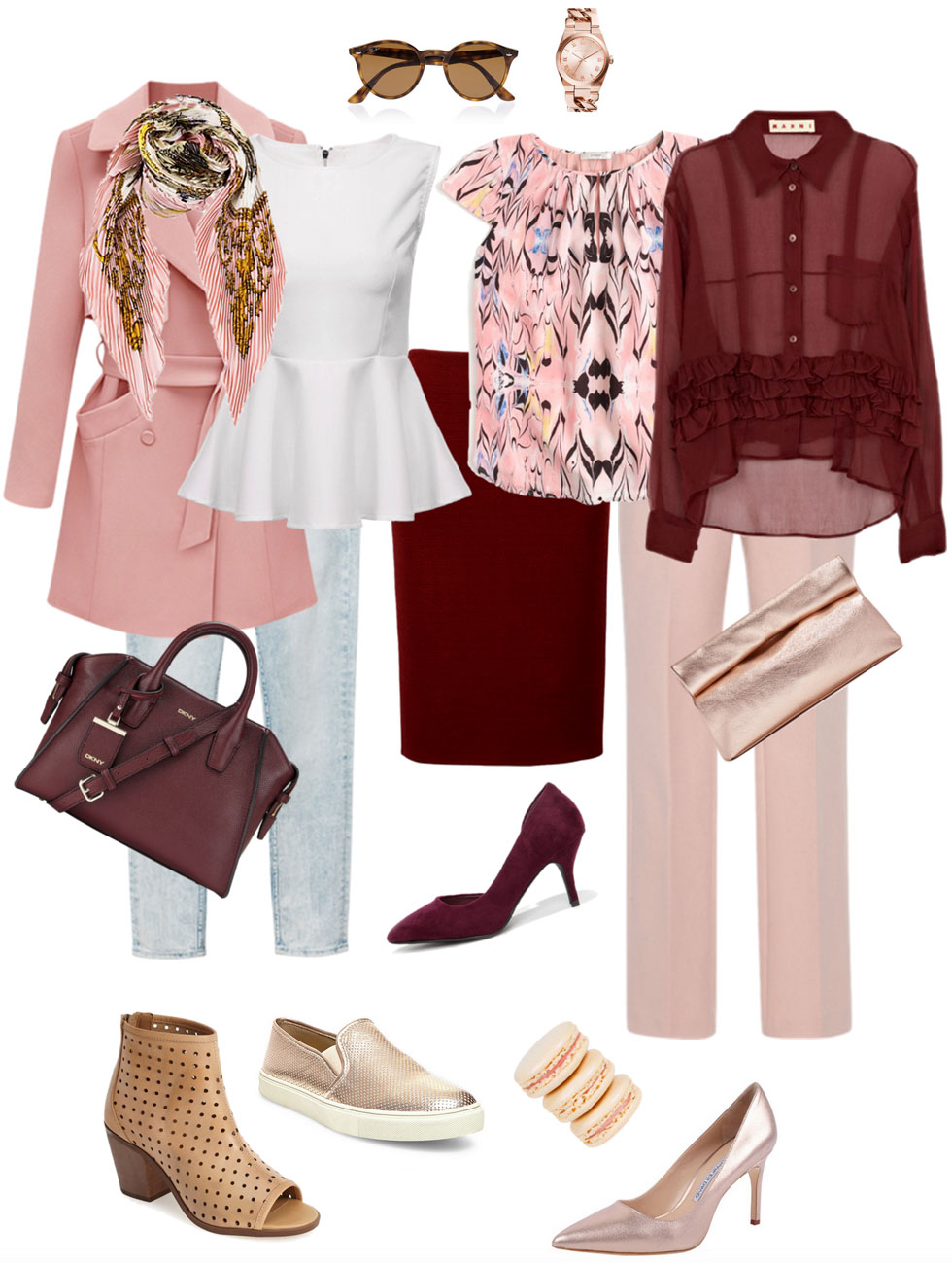
Ensemble: Summer Burgundy & Blush

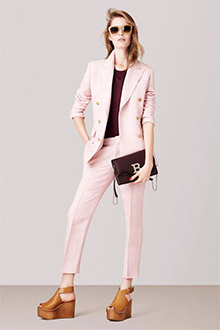
InspirationBurgundy with shades of light pink is a gorgeous combination for Autumn and Winter, but why wait till then? Sport it in Summer just like Bally showed in their 2015 Ready-to-Wear Spring collection. There are many ways to combine burgundy and blush in an outfit. I’ll start the ball rolling with three renditions. 

Jeans, White Top, Burgundy Bag & Blush Accent 

Combine a pair of jeans with a white top. Add the blush in a topper, OR leave off the topper and add a summery blush scarf if it’s too hot for layers. If it’s cool, sport the blush topper and the scarf. Finish off the outfit with a burgundy bag and cognac, tan or metallic shoes. 

Blush Top & Burgundy Bottoms

Combine a burgundy skirt, or a pair of trousers, shorts or jeans with a blush top. The top can be solid or printed. Finish off the look with burgundy pumps, cognac footwear, or metallic shoes. Choose a metallic, burgundy or cognac handbag. 

Burgundy Top & Blush Bottoms

Combine a blush skirt, pair of jeans or trousers with a burgundy top. Again, the top can be printed or solid. Finish off the look with metallic or cognac footwear, and a metallic or burgundy bag. A blush or burgundy topper is a good addition on a cooler day. Add jewellery, eyewear and watch as desired. 

You could also combine a burgundy topper with a blush top and pair of blue or white jeans. Or combine a burgundy dress with a blush scarf and metallic pair of shoes. I love the look of these colours together but don’t wear solid burgundy, so I will enjoy this combination on you.

Ensemble: Summer Burgundy & Blush

Link Love: Fashion Designer Interviews

I was in the mood for a longer read this week, so I thought I’d share one recent and one older article about two different designers who share their thoughts on authenticity and integrity.

The notoriously press-shy Hedi Slimane, Creative Director at Saint Laurent, gave an exclusive, in-depth interview to Yahoo! Style this week in which he discusses the state of fashion in 2015, his relationship with his critics, his strategy for the brand, and many other topics. His thoughts on authenticity resonated with me:

“It takes also forever to make the clothes look like they have always belonged, the credibility of it all. It is an expertise that you keep pushing. You try until it feels just right, and will age accordingly, looking better with time, and looking like you own the clothes you wear. This principle of authenticity applies to everything. Any piece has to feel real, from an evening gown that needs a perfect luxury and couture execution, to a leather jacket or a pair of denim that can’t feel ‘designed’.”

This quote from an older piece on Austrian designer Helmut Lang touches on soul and integrity:

“True to form, Lang doesn’t seem to want just anybody wearing his garments. ‘You hope to find the people who can interpret the soul you try to put into the clothes,’ he says. ‘But they have to interpret it with their own energy, their own soul. It doesn’t work — this is not only for me; I think it’s in general — on people who just buy a label. They don’t really have a relation to it, unless they’re ensured that they can’t be wrong because the label is in fashion. And that always gives, I think, a kind of strange, flat look to the clothes. I think that’s the worst thing that can happen to clothes, basically.'”

Fab Links from Our Members

Celia enjoyed these pantyhose ads of the 1980s for the wackiness of it all, but adds that it also shows how much media presses body image on women. The amount of glamour expected from a pantyhose is just too much.

Annagybe liked these inspiration pictures on how to style the preppy classic polo shirt.

Banoffi found this article about the “Makeup Tax” interesting. The author argues that women have to spend more time and money on their appearance in order to compete with men.

Both she and Deb also wanted to share this article and visual on how sizing has changed over the years.

Joy is liking some recent outfits on The Sartorialist, especially this floral tee pattern mixed look, and this white outfit on the streets of Milan.

The Big Closet Edit

Summer is a great time to do a big closet edit because it’s just before the mad back to school rush. Later in the year schedules will start to fill up as we move closer to the holidays. I’ve written many posts on wardrobe planning and of them it’s “The Six Piles of Closet Editing” that gets to the crux of the matter. I wrote that post three years ago, but it’s still EXACTLY the same procedure I follow when working with clients today so it bears repeating.

A few points upfront:

  • Try to edit your closet in one session because keeping the momentum allows you to judge your closet contents as a whole. It can take up to ten hours to help my clients edit their closets, but four hours is a more realistic time. If you edit your closet very regularly, you’ll be done in an hour. If editing in one go is not an option – tackle one item category or closet area at a time. 
  • Edit ALL areas with wardrobe items. Don’t forget the stuff under the bed, in the spare room closet, in the coat closet, in all those drawers, in the garage, or in the basement. 
  • Re-fit all items before deciding their fate. Your opinion about how an item looks and feels has to be CURRENT. Do not base your opinion on a past memory. This is especially important if you have recently lost and gained weight, or are post pregnancy.  
  • Don’t worry too much about reviewing your closet during the editing process if you’re short on time. Focus on getting the contents down to the right items and revisit your wardrobe for an in-depth review another time. 
  • It’s unrealistic to think that we can create a perfect wardrobe over a set timeframe. It takes time, resources, patience, dedication and an interest in our current fashion era to create a fabulous wardrobe. But we can strive to achieve our wardrobe goals over a longer period of time. Like our style that is on a never-ending journey, our wardrobes are a permanent work in progress. 

Once you’ve carved out some time to edit the contents of your wardrobe, keep the process structured by creating six piles. You might not need to create all six piles, but the options are there just in case. 

Keep

These are the items that spark joy when you wear them. You love the way they look, feel and fit. They’re in good condition, in line with your current style aspirations and make you feel fabulous. It’s that simple. 

IMPORTANT:  Items that are orphaned for a while CAN fit into the keep category. You may have loved wearing certain pieces in the past, but they fell by the wayside when newer items took their place. Orphans do come out of hibernation and back into rotation. So if you still love a piece dearly — keep it. 

Temporary Keep

These are the items that aren’t perfect but you need to hold on to them until they can be replaced. Or they don’t currently fit because of weight loss or gain. Although I firmly believe in dressing the body you’re in today, sometimes it’s worth keeping ill-fitting items if your weight fluctuates. This is especially true if the items were pricey and still in good condition. Either way, don’t let the items that currently don’t fit depress you either. Get them out of your wardrobe and stored somewhere else.

Alteration

It’s amazing how a simple nip, tuck, hack, snap, button adjustment or hem lengthen can transform the fit of an item so that it’s fabulous. Shoes that need repairing and accessories that need to be fixed go into this pile too. 

Holding Zone

This is an interesting pile because it can be large, small or non-existent. These are the items that you’re not sure about, so instead of passing them on right away, you’ll keep them temporarily in an area that is out of sight. Give yourself a chance to miss them for about a year or so, and if you haven’t reached for them at all, pass them on right away.

Items that currently don’t fit because of weight gain or loss can also be held in the holding zone. You’ll get rid of them sooner if you place them in this pile though. Place them in the Temporary Keep pile if the intention is to keep them for longer.

Sentimental

These items are no longer wearable, but you keep them because they are memorable in some way. They tell a story, remind you of a loved one, celebrate an important past occasion or time in your life, or are a token of a great achievement like running a marathon. 

Keep these items in your closet if you have the space because they make you smile when you see them. Or you can box them up so that they are out of the way. Or you can take photos of the pieces and pass on the items themselves.  

Pass On

These are the items that no longer work, or have never worked for your style. Items that are damaged, worn, dated or ruined go into this pile. Items that are ill-fitting, unflattering in some way, overly fussy, impractical, uncomfortable, or are no longer in line with your style goals go into this pile. Get to the heart about WHY the item does not make you feel fabulous and try not to make the same mistake again. 

IMPORTANT: Be careful not to pass on orphans because they’re lacking the support act that completes the outfit. If the item sparks joy, give it a chance by styling it correctly first. There is time to pass it to Goodwill, the Salvation Army and non-profit organizations like Dress For Success later. Or consign the items, sell them on eBay, give them to family and friends, or have a clothing swap party. 

The closet edit process is easier to describe than to execute. I fully understand that it can be an overwhelming and emotional process. If you find yourself losing momentum, there are ways to energize and feel supported during the closet editing process. As with most things, practice makes perfect. The more regularly you edit your closet, the less time-consuming and easier the subsequent edits become. Monthly closet edits are a beautiful thing.
Roundups

Simpler Items

This week's list of top picks list is about basic pieces.

Read More

Assorted Items

Items for Summer, both in and out of air conditioning.

Read More

Casual Summer Vibes

This week's top picks are good for a casual Summer vibe.

Read More

Summery Earth Tones

These items are for those who like to wear casual earth tones in warm and hot weather.

Read More

Hints of Spring

Some tried-and-tested winning items to refresh your style for Spring.

Read More

Dressier Items

An assortment of dressier top picks might be just what the doctor ordered.

Read More

Weekly Roundup: Camisoles

Here’s a selection of camisoles, many of which have worked well on my clients. None of the styles have a shelf bra, so the idea is that you wear your bra underneath them. Most of the styles are cotton-rich, but fits and lengths do differ. There are plenty of colour options so take your pick. 

Personally, I don’t want my camisole to hang too long because I like to tuck it into my bottoms, which keeps it smooth and secure. I also like it to feel snug against my body and breathable, so cotton-rich is best. I wear a camisole 99% of the time — even in hot weather — because I find the feeling of soft snug cotton against my skin very comforting. 

Visit the collection page to see the items alongside my descriptions.

The Lifespans of Different Wardrobe Items

I seem to turn over a significant portion of my wardrobe every five years. Not my whole wardrobe, but somewhere around half of it. I can think of three factors that drive this rate of turnover. 

  1. Many clothing items don’t last much past five years these days.
  2. I enjoy refreshing my style with trendy pieces each season. 
  3. I like to keep my wardrobe a certain size which means that items need to be passed on before I can add new pieces. The one-in-one-out wardrobe principle works well for me. 

The biggest factor, however, seemed to be the category of the item.

Tops have a shorter lifespan than my other clothing items. It’s hard to find knitwear that doesn’t pill after a season or two. White and light woven shirts and blouses tend to discolour after a couple of years. Darker woven shirts and blouses tend to last a little longer, but few make it to the five year mark when you wear them regularly. T-shirt, cotton-rich jersey, and sweatshirt type knitted items tend to last a year or two at best. Items made of polyester on the other hand, can last longer than five years. 

Outerwear, like coats and jackets, frequently make it past the five year mark. My trench coats are eight years and five years old respectively, and still going strong. I’m sure that my tweed equestrian Smythe jackets will make it well past the ten year mark. And my denim jackets seem indestructible. I’ve had one of them for thirteen years, and it still looks new.

Some bottoms, like faded blue and dark jeans, can make it past the five year mark. But white jeans seldom do because of discolouration and the occasional stain. My wool and silk trousers sometimes make it to five years, but start to show a lot of wear. My dresses and skirts tend to make it past the five year mark because I don’t wear them that frequently and because they are, for the most part, quite classic. So the styles don’t date too quickly.

Underwear, loungewear and socks seldom make it past two years. My footwear usually lasts between two and five years, but I’m also wearing footwear that is older than that. The lifespan of my handbags runs the gamut. I will have my Valentino and Chanel handbags for life. My other designer bags last at least five years. But my fast fashion Zara bags and less expensive bags only have a year or two in them before quality issues start to show themselves, or the style is too out of date. 

Given the wide range of lifespans, I don’t think the average tells us a lot. But generally speaking I think it’s good going when you’ve worn a wardrobe item regularly for five years. If it hasn’t dated or worn out by then, you might be ready to pass it on to its new home just because you’re ready for a change.