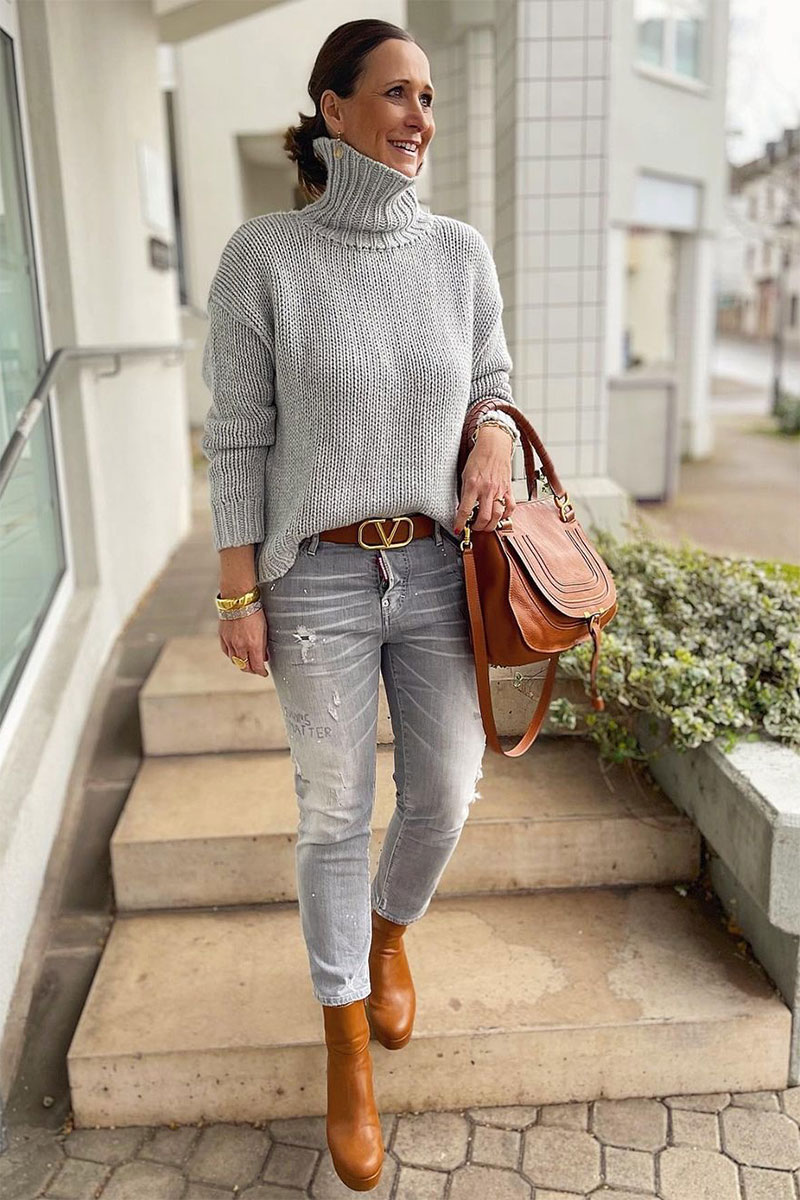
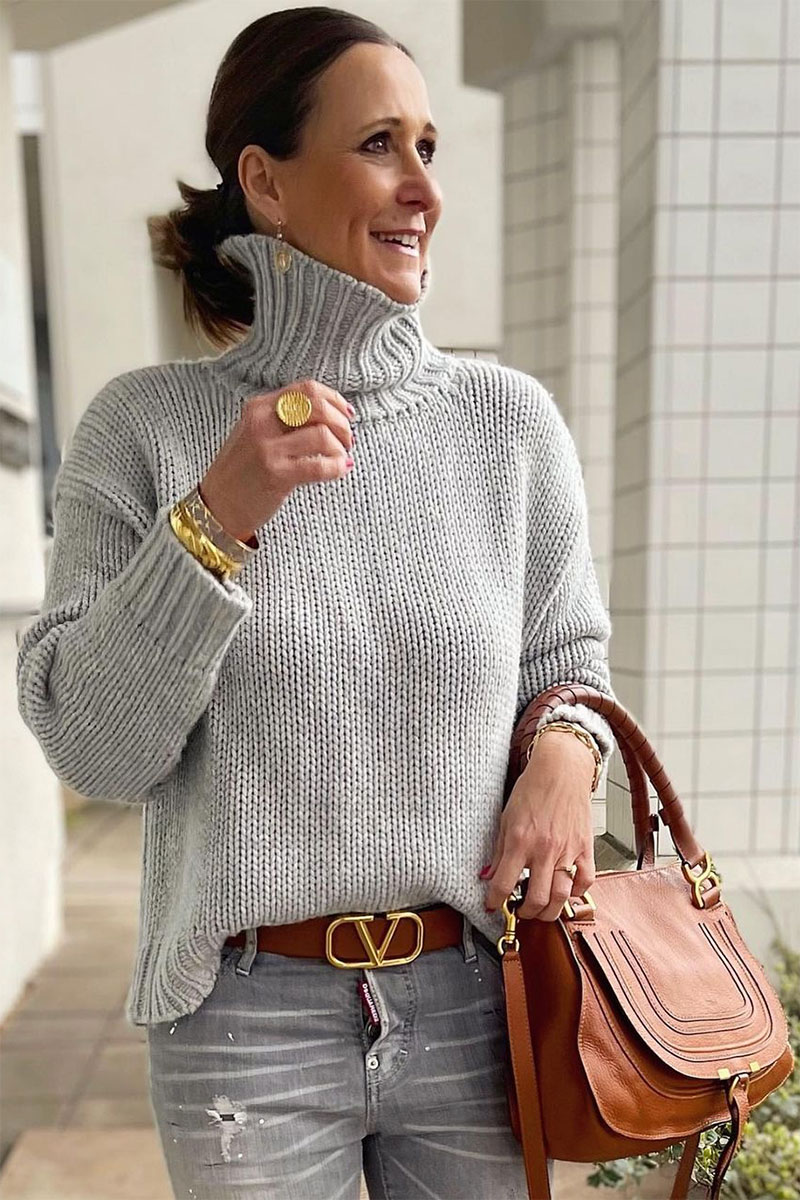
Outfit Formula: Not So Earthy

Earth tones are abundantly available at retail. They’ve been the on-trend colour palette for many seasons, and are still going strong. Many looks showcase earth tones from head to toe, but you don’t need to wear them that way if it’s not your cup of tea. Earth tones are versatile and can be remixed in lots of interesting ways. Here are four ways to make earth tones look less earthy.

1. Add Blue and White

Cool shades of blue and white temper the warmth of earthy shades like cinnamon, mustard, brown and toffee. Here, the blue and white striped top does just that. White footwear picks up the white of the top, and adds a crisp touch. The blue looks much like a slate grey, which shows that dark grey and white can work well with earth tones. If you like to wear earth tones but not near your face, this is one way to go. Adding silver jewellery and hardware cools the earthy palette too.

Add Blue and White

2. Remix with Brights

This is how I wear my own mustard pants (although I like to wear them with navy too). I add colours like fuchsia, shocking pink, tomato red and Dutch orange to the mix. I repeat the brights somewhere else in the outfit so that it looks pulled together. For example, I’d add a solid tomato red, orange, or fuchsia bag and scarf, and throw in some cream boots. The light boots match my hair and white pearls, which further pulls the look together. When I take off my coat, scarf and bag indoors, I’m left with a bright top and mustard pants, which looks good to my eye too.

Remix with Brights

3. Add a Black or White Support Act

Wearing earth-toned bottoms with a black top and shoes is a very easy way to add a harder edge to an earthy palette. The model shows that perfectly here. Bonus that the black slides bookend the model’s hair. Substituting the black with a white top and shoes works as well. Throw in a bag to match.

Add a Black or White Support Act

4. Unexpected Rainbow

This look is unique, yet classic in silhouette. An earthy toffee pencil skirt is matched with an equally earthy mustard twinset. The gold ballet flats complement the warm palette. The addition of the rainbow embroidery on the skirt across all sorts of colours is unexpected, and tempers the earthiness of the rest of the look. You could add an earth-toned bag, a gold bag, or choose a colour in the pattern to repeat. Add jewellery, watch and eyewear as desired.

Unexpected Rainbow

Link Love: The Footwear Sustainability Factor

Shoes are constructed from lots of different materials, which makes recycling footwear quite complicated. Over at En Brogue, Hannah Rochell has good tips on what to do with your old shoes.

This Fashionista article by Elizabeth L. Cline has lots of equivalent suggestions for those of us located in the US.

Fashionista also looks at ‘circular sneakers‘: “Shoes have been a prime target for circular innovation in the last few years. But so far, the movement hasn’t been scaleable.”

Fab Links from Our Members

Nuancedream reports we might need to brace ourselves for issues while doing our holiday shopping this year.

Bijou directs us to an article that will undoubtedly provide extra motivation to reuse and recycle.

Following up on that, Fashintern thought this article could also be of interest.

She also liked The Lingerie Addict’s tips for how to find and shop for sustainable lingerie.

Serena Williams and her Nike design crew debut their first collection. Kkards says: “I’m a huge Serena fan… but even if I wasn’t, these outfits are fab. The models they are shown on, fab. And the overall process and reaching out to and offering accesses and opportunities to underrepresented voices, FAB. This makes me an even bigger fan girl.”

Suntiger points us to the style evolution of one of her favourites, Halle Berry.

Runcarla loves Alison’s attitude about owning one’s personal (jeans) style, and how stylishness and personal style transcend trends.

We have apparently reached peak exercise dress. “Another trend I was oblivious to,” says JAileen.

Full, Ankle, and Cropped Lengths Defined

Pants and jeans come in many lengths, and there is a lot of confusion about the definitions of full-length, ankle, and cropped lengths. It doesn’t help when retailers sometimes classify lengths differently. I’m pedantic about lengths, so here are my definitions, which might differ from those used by other fashion professionals. Note that the definitions refer strictly to lengths, and not silhouettes.

Full Length

Pants and jeans are full length, and sometimes called regular length, when they completely cover the ankle bone and ankle. Full lengths will vary from just covering the ankle bone and skimming the tops of shoes, to sweeping the floor and covering most of the shoe. Choose a full length that works for you and the type of footwear you like to wear with the bottoms.

Ankle Length

Ankle pants and jeans showcase the ankle bone, and do not cover the ankle. That is the point of ankle pants. They are shorter than full-length pants. Hems usually finish right above the top part of the ankle bone when standing. Sometimes lengths partly cover the ankle bone, but personally, I find those a little long for ankle pants. They look more intentional when you showcase the full ankle. Otherwise it might look like you’re wearing full-length pants that are too short.

Cropped Lengths

Cropped pants and jeans are any length shorter than full length. They can be cropped anywhere from right above the top of the ankle bone and up to six inches above it. Ankle pants are a specific type of cropped pant. Some people maintain that cropped pants are shorter than ankle length pants, but to me, anything that is shorter than full length is cropped.

The trick is to find your sweet spot for cropped pants. I’ve worn both shorter and longer cropped pants. I tend to like a length two inches above the top of my ankle bone when standing, depending on the silhouette and the shoes I wear with them. Sometimes I wear them an inch, or three inches above my ankle bone. Remember that when you cuff or roll the hems of pants and jeans, you are cropping their length too.

Feel free to ask questions in the comments if things are still not crystal clear.

Roundups

Simpler Items

This week's list of top picks list is about basic pieces.

Read More

Assorted Items

Items for Summer, both in and out of air conditioning.

Read More

Casual Summer Vibes

This week's top picks are good for a casual Summer vibe.

Read More

Summery Earth Tones

These items are for those who like to wear casual earth tones in warm and hot weather.

Read More

Hints of Spring

Some tried-and-tested winning items to refresh your style for Spring.

Read More

Dressier Items

An assortment of dressier top picks might be just what the doctor ordered.

Read More

Organized Emotional Shopping

Inspired by a number of shopping and wardrobe management threads on the forum recently, I’m republishing a post that suggested you should listen to your heart as much as your head when adding items to your wardrobe. Try to find a stylish balance between being overly organized and too emotional when it comes to shopping.

Wardrobe purchases that address your needs will eliminate the feeling of having a closet full of clothes and nothing to wear. So keep a list (in your head or on paper) of wardrobe holes, items that need updates, and new trends that tickle your fancy. Regular closet reviews and edits improve the accuracy of your list. 

This is a practical and organized approach to shopping for wardrobe items. It forces you to think about the way individual items can be combined to create effective outfits, and the way they work with other items to create efficient capsules. 

On the other hand, I have also found that shopping is most successful when it is accompanied by a high level of positive emotion. A great item is love at first sight, you love the way you look when you try it on, and you feel like you can’t live without it. It is only an item of clothing, but it makes you happy to bring it home. And it continues to make you happy whenever you put it on.

Organization and emotion are both important. The problem comes in when shopping is either overly organized or too emotional.

Overly organized shopping can lead to a wardrobe that you don’t love as much as you should. By focussing on lists, numbers and analytics, you forget to listen to your heart. You aren’t allowing that all-important emotional spontaneity to help you guide your purchases to what feels right, both physically and emotionally. Any conscious analysis we do can never completely capture our ever-changing needs and preferences. Sometimes our intuition knows better. So the plan is a very useful guide, but sometimes we need to trust our intuition and ignore it.

Of course, relying too heavily on your emotions when shopping is equally problematic because you forget to purchase for your needs. You can fall into the trap of shopping for an imaginary life, duplicating items unnecessarily, or having a closet full of items you love, but that don’t work together in outfits and capsules. Your emotions need to be focussed on the right pieces in order to create a functional wardrobe.

The answer is to consult both your head and your heart when adding to your wardrobe. Have a good plan, but make it flexible. You will come across items that speak to your emotions. If they are on your shopping list, so much the better. If not, and if the item works for your lifestyle, don’t ignore what your heart is saying to your head.

Pull Looks Together by Creating Complements

I’ve posted about complements several times on YLF, and it bears repeating because a functional wardrobe has items that relate to each other, where items can be easily mixed and matched to create outfits that look and feel great. One way to create such a wardrobe is through building and wearing what I call complements.

A complement is a small group of accessories and footwear that match in colour, pattern or vibe, and can be worn together. Adding the items from a complement to an outfit makes it look more cohesive and rich, and gives it a punchy finishing touch. I create seasonal colour complements with footwear, bags, scarves, belts and sometimes eyewear. But most are created with shoes, scarves and a handbag or two.

When I shop to refresh my wardrobe, I think about the complements that I have, how I can build on to them, and which complements I might build from scratch. As I was shopping this year’s Nordstrom Anniversary Sale (NAS), I had light neutrals like cream and oatmeal in mind. I have all sorts of optical white and off-white shoes, bags and belts to create complements with, but I don’t have a complement in a rich cream. Although I happily mix shades of white, I also like to match them. And because white wardrobe items are my thing and white is the most important neutral for my style, creating a cream complement is not a duplication.

I had a successful NAS, and unexpectedly came home with two pairs of cream shoes. A pair of loafers and a more refined pair of combat boots, neither of which I have in a rich shade of cream. I saw a great cream barrel bag and an oatmeal cashmere scarf that together with the shoes, would complete the complement. The bag is absolutely darling and beautifully made. It’s a richer cream than the stock photo and matches perfectly. The oatmeal cashmere scarf is darker but works well. It’s an unusual shorter length that is easier to tie and tuck into outerwear. The texture is pretty too. The collection shows the exact pieces of the new complement.

Complements are an easy, versatile and effective styling tool, which is why I go to the trouble of planning and creating them. They can be worn over and over again, season after season, and have a high longevity factor. Complement building also means combining old wardrobe items with new items, which gives me great satisfaction because I don’t like forgetting about my old stuff. So I bought the same cashmere scarf in light blue with an aqua tinge to match a handbag I’ve had for six years. It doesn’t look like it in the stock photos, but they are a perfect colour match. I’m in no rush, but it would be nice to eventually find a pair of hi-tops or boots in the same shade of blue.

I tend to stick to solid complements because I wear a lot of pattern. Some of my clients add patterns to their complements, and do so with scarves, or animal print bags and shoes. That’s because they generally wear solids allowing the patterns to emerge in complements.

Over to you. Do you build outfit complements with footwear and accessories? If so, do you find it an effective styling tool because it helps pull a look together.